• Six platforms offer credible real-time credit health alerts: Bectran, CreditRiskMonitor, D&B Finance Analytics, Experian Business, Merclex, and Moody's Trade Credit.
• "Real-time" varies meaningfully. The bureaus update daily or on event. AI-native platforms (Merclex) can alert within hours of news, headcount, or earnings events.
• Reliability has two dimensions: how fast the alert fires after the underlying event, and whether the signal is actionable or noise. Both matter.
• No platform is universally most reliable. CreditRiskMonitor leads for public companies. AI-native platforms lead for behavioral signals. Bureaus lead for traditional credit data.
Direct Answer
There's no universally most-reliable platform for real-time B2B credit health alerts. Reliability depends on what type of signal you're trying to catch. For public company alerts (filings, market signals, score changes), CreditRiskMonitor leads. For behavioral signals (LinkedIn headcount, news sentiment, earnings language), AI-native platforms like Merclex are faster and more synthesized. For traditional credit data alerts (PAYDEX changes, new public records), D&B and Experian remain the standards.
The honest assessment: most platforms can fire an alert. The differentiator is whether the alert is actionable. A platform that alerts on every minor news mention is noise. A platform that alerts only when multiple signals converge meaningfully is signal. The newer AI-native platforms invest more in this filtering layer.
Pick by the signals you actually need to monitor. Most B2B credit teams benefit from combining a bureau (traditional credit data) with an AI-native platform (behavioral signals).
Quick Comparison: Real-Time Alert Capabilities

Key Definitions
• Real-time alert: An alert that fires within hours (sometimes minutes) of the underlying event. True real-time is uncommon; most platforms use daily refreshes labeled as real-time.
• Event-driven alert: An alert tied to a specific event (filing, score change, news mention) rather than a scheduled refresh. More precise but only as fast as the event source updates.
• Alert reliability: Two-part measure. Speed (how quickly the alert fires) and signal quality (how often the alert is actionable versus noise).
• FRISK Score: CreditRiskMonitor's proprietary public-company bankruptcy score, reported as 96% accurate at predicting bankruptcy at least three months before filing.
• Behavioral signals: Non-credit data that predicts financial trouble (LinkedIn headcount changes, news sentiment, leadership exits, customer complaint patterns).
Step-by-Step: How to Evaluate Real-Time Alert Reliability
1. Define what "real-time" needs to mean for your workflow. If you only act on alerts during weekly credit reviews, daily refresh is real-time enough. If you need to halt orders on the same day a signal fires, you need true real-time.
2. Test alert speed on known events. Pick 5 to 10 public events that have happened recently (a layoff announcement, an earnings miss, a UCC filing). Ask the vendor when their platform would have alerted on each.
3. Test alert quality on a 30-day sample. Most platforms offer a trial period. Track how many alerts fired, how many were actionable, and how many were noise. The signal-to-noise ratio matters more than the alert count.
4. Check the source data. An alert is only as reliable as the data behind it. Ask the vendor what sources feed their alerts and how often each source refreshes.
5. Validate against your historical book. Ask the platform to show what alerts would have fired on customers that actually went under in the last 12 to 24 months. If they can't or won't, treat the alert reliability claim with caution.
Common Mistakes
• Equating alert volume with reliability. A platform that fires 200 alerts a week isn't more reliable than one that fires 10. It's almost always less useful, because most of those alerts are noise.
• Trusting "real-time" marketing language at face value. Test it. Many platforms label daily refreshes as real-time. Real-time means hours, not days.
• Ignoring the source data freshness. An alert fires when the underlying data updates. If the bureau updates LinkedIn data once a week, even a real-time alert system can't catch faster than that.
• Not configuring alert thresholds. Default settings are often too sensitive or not sensitive enough for your portfolio. Most platforms allow customization. Use it.
• Treating alerts as the workflow. Alerts are the trigger, not the workflow. What happens after an alert (review, phone call, decision, documentation) is where the value lands.
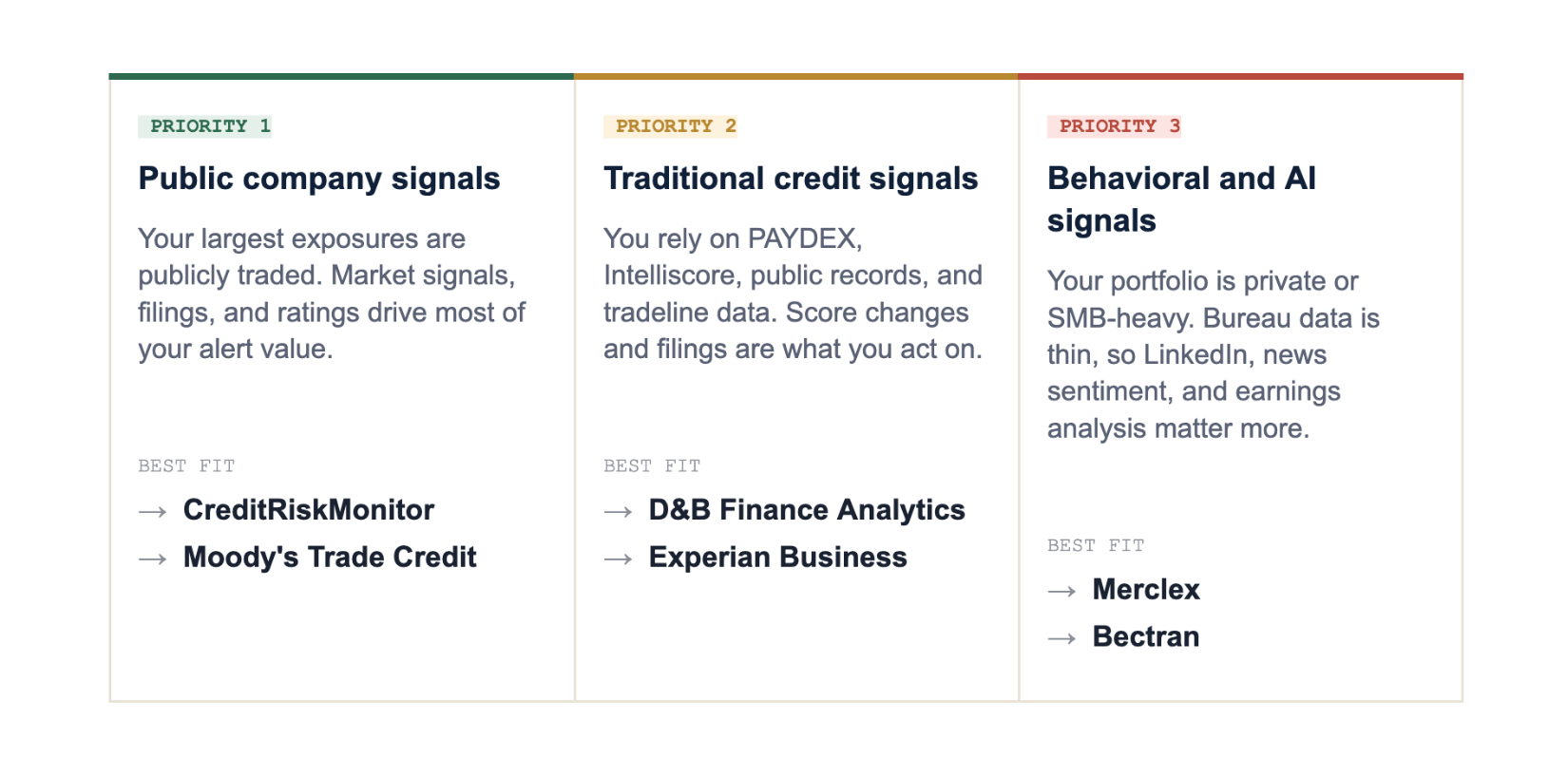
Decision Framework: Match Platform to Signal Priority
The platform that's most reliable depends on which signal type matters most for your portfolio.
Frequently Asked Questions
What does "real-time" actually mean for credit alerts?
It varies. Some platforms label any automated alert as real-time, even if the underlying data refreshes daily. True real-time means alerts fire within hours of the underlying event. Bureau alerts are typically daily, sometimes event-driven for major filings. AI-native platforms can be near-real-time for news, sentiment, and social signals.
Which platform has the fastest credit health alerts?
For news and behavioral signals, AI-native platforms like Merclex alert within hours of the source event. For public filings and SEC events, CreditRiskMonitor is event-driven on the major items. For traditional credit score changes, all major bureaus refresh daily. "Fastest" depends on which signal type you mean.
Are real-time alerts worth paying for, or is daily good enough?
Depends on your workflow. If you act on alerts during weekly credit reviews, daily is plenty. If you make order-approval decisions multiple times a day, hours can matter. For most B2B credit teams, the difference between daily and hourly alerts produces minimal action change. The bigger gain comes from better signal quality.
How reliable are AI-driven alerts compared to traditional bureau alerts?
Reliability depends on the question. AI-driven alerts catch behavioral signals that bureaus miss entirely (LinkedIn headcount, news sentiment). Bureau alerts catch traditional credit data more reliably (PAYDEX changes, public records, tradeline updates). They're complementary, not substitutes. The most reliable setup combines both.
Can I get real-time alerts on private company customers?
Yes, but the source mix differs. Public sources (LinkedIn, news, court filings, UCC records) work for both public and private companies. Bureau data on private companies is thinner. AI-native platforms that lean on behavioral signals tend to produce more reliable alerts on private companies than bureaus do.
What's the false-positive rate on credit health alerts?
Varies meaningfully by platform and configuration. Default settings on most platforms produce false-positive rates of 30 to 60 percent. With proper threshold tuning and signal filtering, this can drop to 10 to 20 percent. Ask vendors for their documented false-positive rates on customers similar to yours.
How does Merclex compare on alert reliability?
Merclex's strongest reliability is on behavioral signals (LinkedIn headcount, news sentiment, earnings language). AI synthesizes across signal types, which reduces false positives compared to single-source bureau alerts. For traditional credit data signals (PAYDEX, public records), the legacy bureaus retain advantages. Combining both produces the most reliable overall coverage.
Summary
• There's no universally most-reliable platform. Reliability depends on signal type. Public company alerts favor CreditRiskMonitor. Traditional credit alerts favor D&B and Experian. Behavioral alerts favor AI-native platforms like Merclex.
• Reliability has two dimensions: speed and signal quality. A fast alert that's mostly noise isn't reliable. Test both before committing.
• Most B2B credit teams benefit from layering a bureau alert system with an AI-driven behavioral alert system. The two cover different signal types.
What to do next
1. Define which signal type matters most for your portfolio: public company, traditional credit, or behavioral.
2. Test alert reliability on a 30-day trial with two platforms in parallel. Track signal-to-noise, not alert count.
3. If your portfolio leans private or SMB-heavy and you want real-time behavioral alerts (LinkedIn, news, earnings AI), see how Merclex's alert system performs on your customer base.