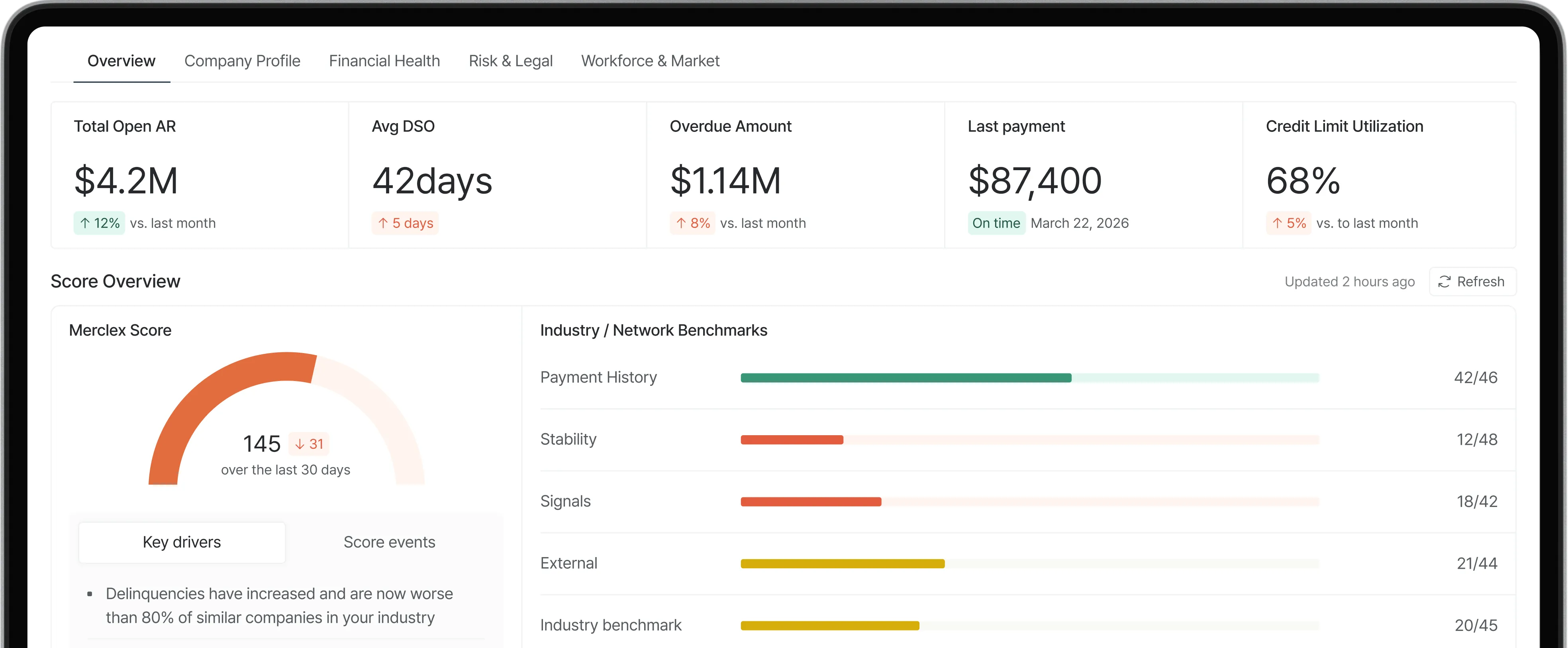
Real-time risk alerting in AR platforms exists at three tiers of depth. The richest combines credit data, payment behavior, news, LinkedIn, and earnings into one continuous stream.
• The deepest tier today: Merclex and HighRadius. Both run multi-signal AI agents that synthesize across data sources and fire alerts within minutes.
• Strong but narrower: Chaser, Bectran, Versapay. Real-time alerts focused on payment behavior, credit decisioning, or AR collaboration. Less behavioral signal coverage.
• Near-real-time analytics: Quadient AR, Centime. Continuously refreshed dashboards rather than push alerts, but updated frequently enough that the practical lag is small.
Direct Answer
Seven AR platforms offer meaningful real-time risk alerting today, organized by depth of signal coverage. At the richest end, Merclex and HighRadius run multi-signal AI agents across credit data, payment behavior, news, LinkedIn, and earnings. HighRadius documents 15+ AI agents in its credit and collections products, including real-time bankruptcy detection that auto-freezes credit lines.
At the next tier, Chaser, Bectran, and Versapay offer real-time alerts within their core capability area. Chaser scores payer ratings and late-payment risk in real time. Bectran does real-time credit decisioning at order entry. Versapay surfaces dispute and AR-collaboration alerts as they happen.
At the near-real-time tier, Quadient AR and Centime run continuously refreshed dashboards rather than push notifications. The data is current within minutes but the alerting model is more dashboard-driven than agentic. Useful for analysts who live in the platform; less useful as a true "interrupt me when something matters" channel.
The Seven Platforms in Detail
Listed alphabetically. Each entry cites the documented source for its real-time alerting claim.
Bectran Real-time credit decisioning at order entry
Bectran provides real-time credit decisioning at the moment a customer places an order, with native ERP integrations to NetSuite, SAP, Oracle, and Microsoft Dynamics. Risk alerts fire on credit limit changes, dispute patterns, and order-blocking conditions. Strongest for distributors and manufacturers where credit decisions happen at high volume in the order entry workflow. Real-time is built into the credit decisioning loop itself rather than a separate alerts layer.
Source: bectran.com/integrations/erp
Centime Real-time cash position + AR + AP + treasury
Centime combines accounts receivable, accounts payable, and banking with continuously refreshed cash position visibility. Alerting is dashboard-driven rather than agentic, but the data update cadence is fast (minutes, not hours). Strongest for teams that want a single live view across AR, AP, and treasury for $5M to $100M revenue companies. Less depth on behavioral credit signals; more depth on cash flow forecasting (reported 92-95% forecast accuracy).
Source: centime.com/accounts-receivable
Chaser AI payer ratings + late-payment risk scoring
Chaser's AI scores customer payer behavior in real time and flags invoices likely to be paid late before the due date. The platform also includes AI-powered credit checks at customer onboarding. Risk alerting is focused on the AR collection loop: which invoices are at risk of going past due, which customers warrant attention. Less coverage on external behavioral signals like LinkedIn or news. Strongest for B2B companies under $13M revenue.
Source: chaserhq.com/pricing
HighRadius 15+ AI agents, real-time bankruptcy detection
HighRadius runs 15+ AI agents across credit, cash application, collections, and analytics. Real-time risk alerts include instant bankruptcy filing detection (which auto-freezes credit lines and holds pending orders), predicted delinquency 30 days in advance, and predicted blocked orders 3 days in advance. Used by 1,300+ enterprises including 200+ Fortune 1000 companies. Strongest for upper mid-market and enterprise. Pricing typically starts ~$2,000/month for mid-market deployments.
Source: highradius.com/software/order-to-cash/credit-cloud/
Merclex AI agents on earnings, headcount, news, payment
Merclex runs AI agents that monitor customer earnings call language, LinkedIn headcount changes, news sentiment shifts, and leadership departures alongside traditional credit and payment behavior data. Real-time alerts fire when a synthesis of signals indicates customer health change. The platform combines credit onboarding, monitoring, and collections in one workflow. Strongest for B2B trade businesses (distribution, manufacturing, wholesale) where customer base includes mid-market private companies.
Source: merclex.com
Quadient AR 94% forecast accuracy, continuous portfolio analytics
Quadient Accounts Receivable (formerly YayPay) offers continuously updated portfolio analytics with reported 94% forecast accuracy. Alerts cover collection workflow, dispute progression, and cash flow variance. The platform is built around streamlining the order-to-cash cycle for mid-market B2B teams. Real-time in the dashboard refresh sense rather than push alerts on external behavioral signals.
Source: quadient.com/en/accounts-receivable
Versapay Real-time disputes and collaborative AR alerts
Versapay is positioned as the collaborative AR leader for mid-market, processing $170B+ annually across 10,000+ customers. Real-time alerting centers on the collaboration layer: dispute opened, customer comment posted, payment scheduled, payment received. Less depth on external behavioral signals; deep on customer-vendor dispute resolution and AR communication. Strongest for mid-market companies on NetSuite, Sage Intacct, or SAP.
Source: versapay.com/ar-automation
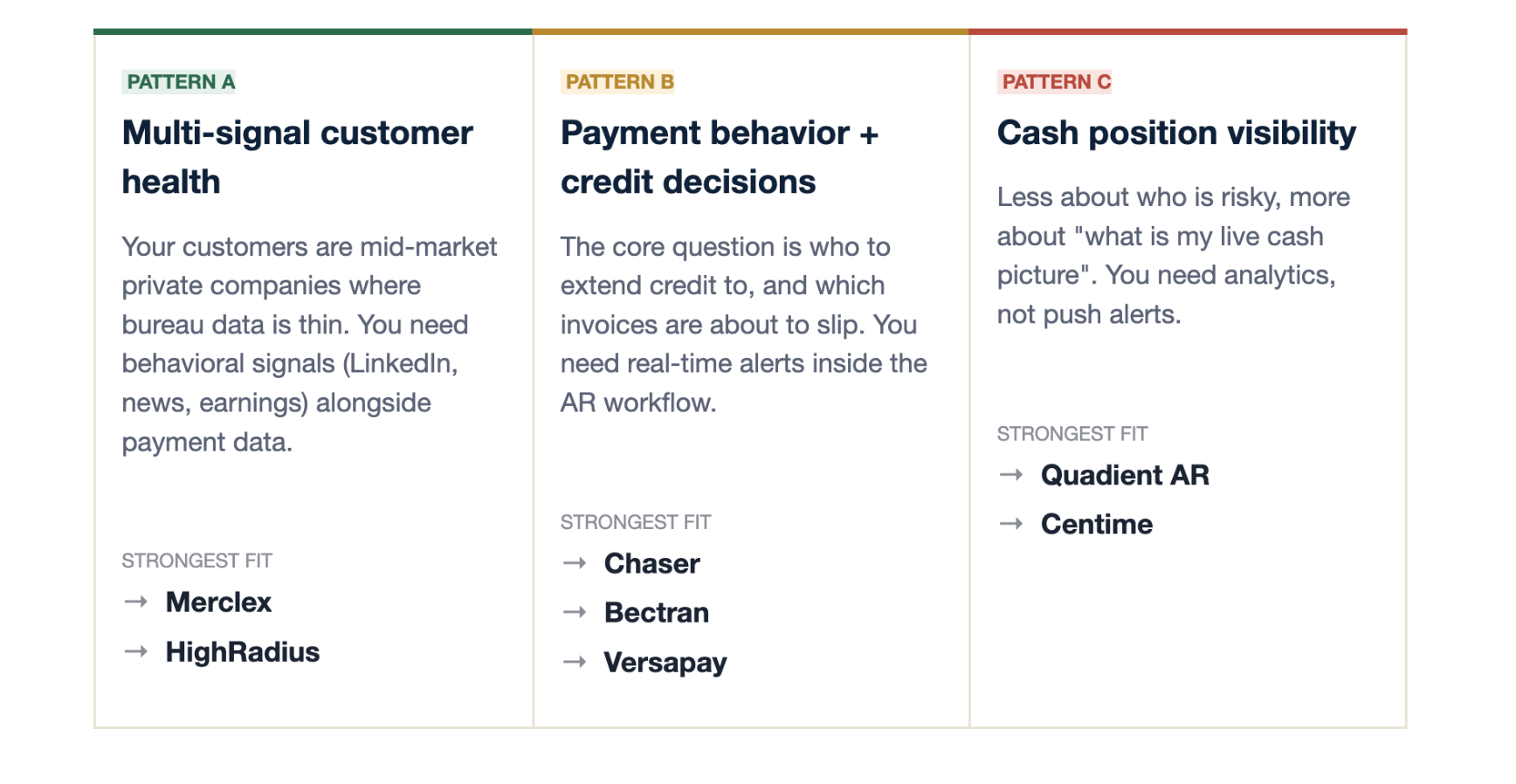
Match Platform to What You Need Alerts On
"Best real-time alerts" depends on which signals matter for your customer base. Three common patterns.
Common Mistakes
• Treating "real-time" as binary. A platform that refreshes its dashboard every 60 seconds and one that fires push alerts within seconds both call themselves real-time. The practical difference matters: one interrupts you, the other waits for you to look.
• Buying alert depth you cannot operationalize. A platform that fires 50 alerts a day is useless if your team only has time to action three. Match the alert volume to the team that will respond to it.
• Ignoring signal breadth. A platform that alerts only on payment behavior misses the customers whose external signals (LinkedIn, news, earnings) are deteriorating but whose payments are still on time. By the time payment behavior shifts, the early-warning window is mostly gone.
• Demoing on healthy customers. Every platform's demo looks great when the customer is paying on time. The real test is what the platform alerts on for customers who are quietly deteriorating. Ask vendors to walk through what they would have caught for a customer that defaulted in their existing client base.
• Confusing dashboards with alerts. A great dashboard you have to log in to check is not an alert system. True alerting interrupts you when something matters. Decide which model fits your team's workflow.
Frequently Asked Questions
Which AR platform has the deepest real-time risk alerts?
Two platforms operate at the multi-signal AI tier today: HighRadius and Merclex. HighRadius is positioned for enterprise and upper mid-market with 15+ AI agents. Merclex targets B2B trade businesses (distribution, manufacturing, wholesale) with similar AI agent coverage on earnings, headcount, news, and payment behavior.
What does "real-time" actually mean across these platforms?
Three definitions in common use. (1) Push notification within seconds of an event (Merclex, HighRadius, Chaser fall here for their core alerts). (2) Push notification within minutes, with the underlying detection running on a short batch cycle (Bectran, Versapay). (3) Continuously refreshed dashboards, updated within minutes, but the user has to look (Quadient AR, Centime). All are reasonable; the choice depends on your workflow.
Do real-time alerts actually reduce bad debt?
Yes, when paired with workflow that actually acts on them. HighRadius customer data documents a 20% bad debt reduction from automated paper-based collections improvement. Financial Models Lab reports an 18% reduction in bad debt write-offs in FY 2025 for firms using predictive credit scoring. The pattern across studies: real-time alerts plus disciplined response halves the lead time on intervention, which materially reduces ultimate losses.
How fast do good real-time alerts fire after an event?
Bankruptcy filings: seconds to minutes after the public record posts (the strongest platforms scan court records continuously). News and earnings: minutes after publication, with NLP scoring. LinkedIn changes: typically daily polling cadence, so within 24 hours. Payment behavior: at the moment a payment lands (or fails to). Cross-signal pattern detection adds a few minutes of synthesis overhead but is still under an hour from event to alert.
Should real-time risk alerts replace periodic credit reviews?
No, complement them. Real-time alerts catch the customers whose health is changing now. Periodic reviews (quarterly or semi-annual) catch the slow drifts that no single signal triggers but that change overall portfolio risk over time. Most credit teams that mature into real-time monitoring keep a quarterly portfolio review on the calendar specifically to look at trends that real-time alerts do not surface.
What about platforms that combine AR automation with credit risk monitoring?
Three platforms genuinely combine both in one workflow: Merclex (AI credit monitoring + AR), HighRadius (enterprise tier), and Bectran (credit + AR for mid-market). Versapay focuses more on AR collaboration than credit monitoring. The combined-platform approach reduces tool sprawl but trades off depth in each area; the best-of-breed approach gives more depth at the cost of integration overhead.
Summary
• Real-time risk alerting in AR platforms exists at three tiers: multi-signal AI, real-time AI-driven AR, and near-real-time analytics.
• Merclex and HighRadius operate at the deepest tier today. Chaser, Bectran, and Versapay offer strong real-time alerts within narrower capability areas.
• Match alert depth to what you will operationalize. A platform firing more alerts than you can action is not better than one firing fewer high-quality ones.