TL;DR: Paidnice is a collections suite, the deepest toolkit for chasing overdue invoices on Xero and QuickBooks. Merclex brings credit and collections together, screening customers and monitoring risk before invoices go late, then collecting too, with a free starter tier. Pick Paidnice to chase harder, Merclex to stop bad debt before it starts.
If you sell to other businesses on terms, you already know the slow bleed of late invoices. You did the work, you sent the invoice, and now you are spending your week writing reminder emails instead of running your business. Paidnice and Merclex are both built to take that off your plate. The question is how much of the problem each one actually solves.
The numbers behind the pain are not subtle. 92% of businesses still get paid late, and US small businesses are owed more than $17,000 each on average in unpaid invoices. Automating the chase helps a lot: businesses that use AR automation are 52% more likely to be paid within two weeks, and most teams cut their DSO by 10 to 20 days. Both tools in this comparison will do that for you.
The real difference is scope. Paidnice is a collections enforcement engine: it chases overdue invoices harder and smarter than you ever could by hand. Merclex covers the whole credit-to-cash cycle, screening customers before you sell to them, monitoring their risk while invoices are still current, and then automating collections. One perfects the chase. The other tries to make sure you never extend credit to the wrong customer in the first place. This guide breaks down where each one wins.
Merclex vs. Paidnice, in One Minute
Choose Paidnice if your only goal is to automate collections on Xero or QuickBooks. It is the most complete enforcement tool for small business, with automated late fees, compounding interest, escalation workflows, dispute letters, payment plans, and a self-service payment portal, all on flat pricing that starts at $69 per month. If you already vet your customers and just want to get paid faster, it is hard to beat.
Choose Merclex if late payment is a symptom of a bigger problem: you are extending credit without really knowing who you are extending it to. Merclex screens every new customer with an AI credit application and fraud checks, monitors each one for risk signals while their invoices are still current, and then automates collections by who is actually most likely to default. It has a free starter tier, so you can begin without committing a budget.
The short version: Paidnice fixes how you chase. Merclex fixes who you extend credit to, then chases too. If you have ever been blindsided by a customer who looked fine and then quietly stopped paying, that gap is the whole reason to look at Merclex.
Merclex vs. Paidnice at a Glance
Here is how the two tools compare on the points that decide most purchases. The full breakdown follows.
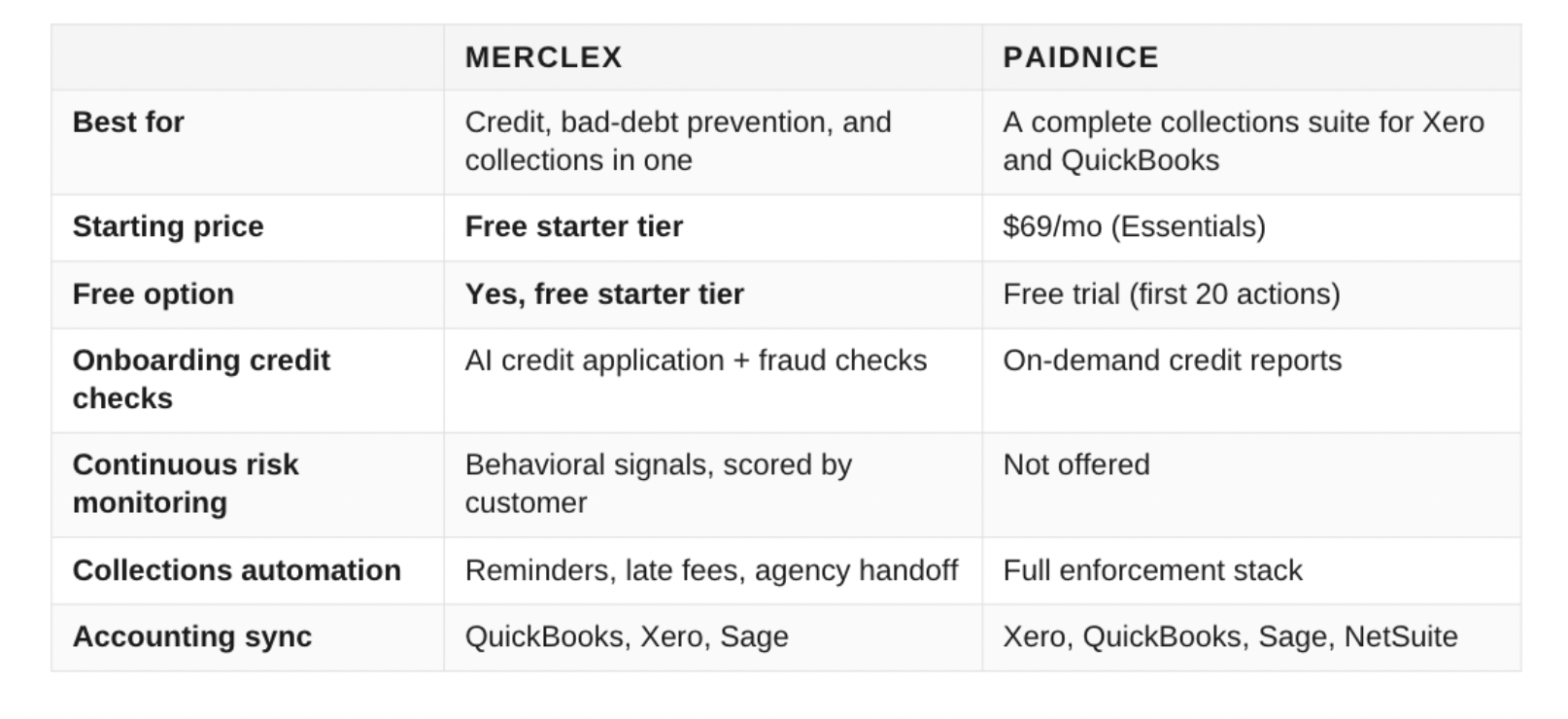
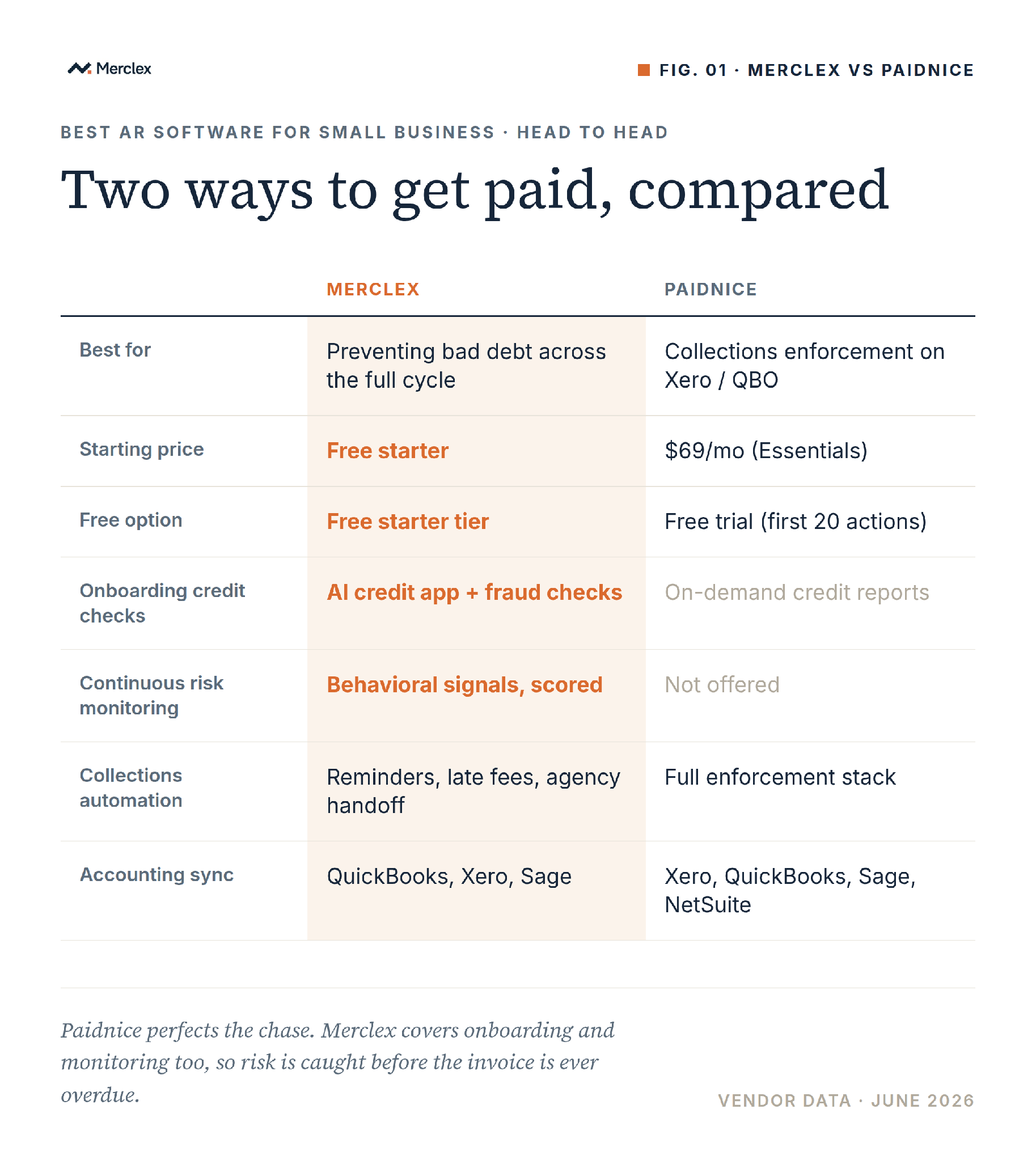
Merclex and Paidnice side by side. Paidnice perfects the chase; Merclex adds onboarding and monitoring, so risk is caught before the invoice is ever overdue.
What Is Merclex?
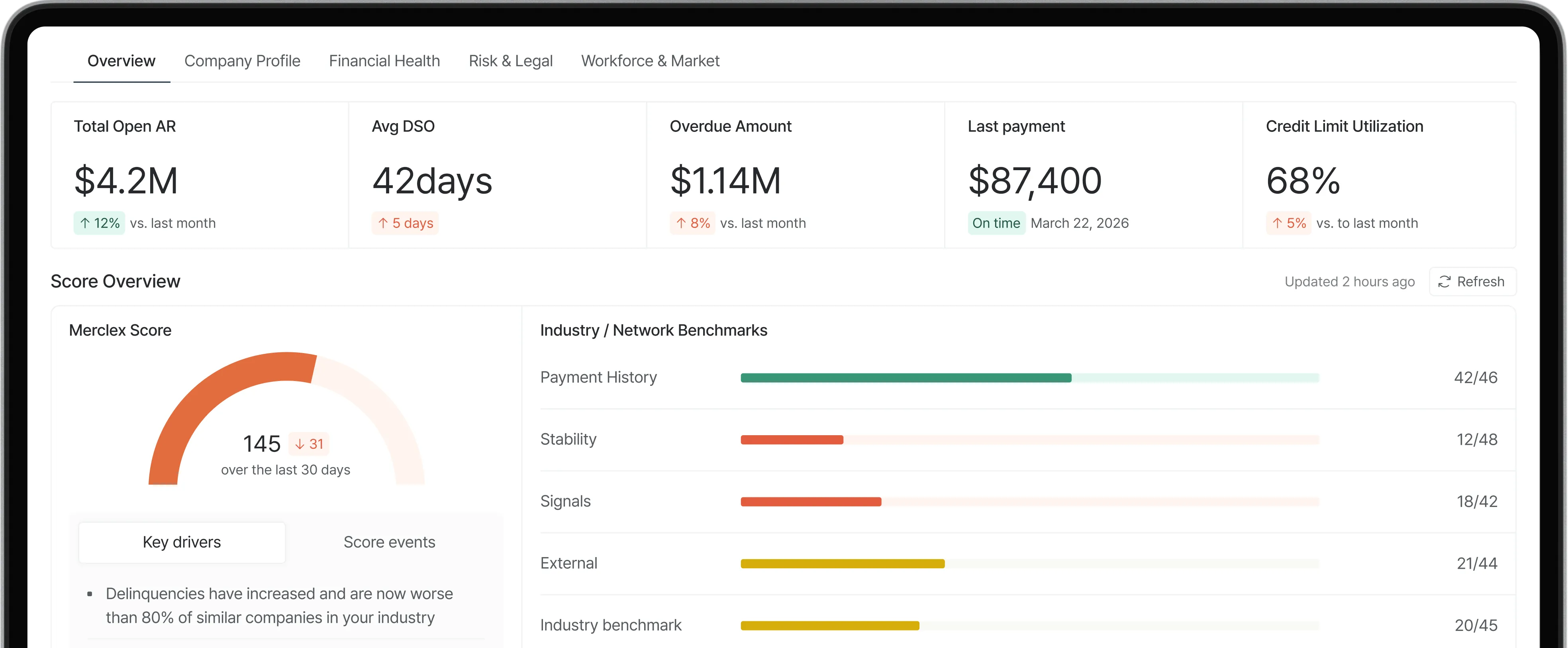
Merclex is a B2B credit and collections platform that covers the full credit-to-cash cycle in one tool. Before you sell to a new customer, it runs an AI credit application with built-in fraud checks (EIN lookup, OFAC and sanctions screening, and domain and address verification) and recommends credit terms. While their invoices are still current, it monitors each customer for behavioral risk signals like leadership departures, headcount drops, negative news, earnings misses, lawsuits, and liens, scored by how important that customer is to you. Then it automates collections with personalized email and text sequences, auto-calculated late fees, and one-click handoff to a collection agency.
It connects to QuickBooks, Sage, and Xero, and the starter tier is free. The point of Merclex is consolidation: the credit application, the monitoring, and the collections that most businesses stitch together from three separate tools (or run on PDFs and manual reminders) live in one place.
What Is Paidnice?
Paidnice is accounts receivable and collections automation built for small and mid-size businesses on Xero and QuickBooks Online. It was named the 2025 Xero Global Small Business App of the Year, and since 2022 it has facilitated on-time payments across more than $4 billion in transactions and 3 million invoices. Customers report reducing Days Sales Outstanding by an average of 25%.
Where most AR tools stop at reminders, Paidnice gives you the full enforcement stack: automated email and SMS reminders, a rules engine for late fees and compounding interest, escalation workflows, dispute letters, payment plans, customer statements with 30/60/90 day aging, prompt payment discounts, and a self-service payment portal. Configurable rules let you be firm with chronic late payers while staying gentle with your best customers. It also lets you order business and consumer credit reports on demand to inform a credit decision, though it does not run an automated credit application at onboarding or monitor customers continuously.
Merclex vs. Paidnice, Compared Head to Head
Both tools automate getting paid. The differences show up the moment you look at where in the process each one goes to work.
Pricing and Value
Paidnice uses flat, predictable pricing. Essentials is $69 per month and covers up to 150 invoices monitored, 600 emails, and 2 team members. The Pro plans are tiered by invoice volume, running $99 per month for up to 300 invoices and $179 per month for up to 600, with custom pricing above that. There are no revenue caps, so your bill tracks invoice volume rather than how much you earn. The free trial covers your first 20 actions. Merclex starts with a genuinely free starter tier, with paid plans that scale as you use more. For pure budget predictability at steady volume, Paidnice is easy to model. For starting at zero cost, Merclex wins.
Collections and Enforcement
This is Paidnice’s home turf, and it is excellent here. The rules engine handles flat fees, percentage fees, compounding interest, grace periods, and variable rates per customer group, tag, or line item. Sender profiles let you escalate reminders through different contacts as an invoice ages, from an AR clerk to a finance manager to the owner. Dispute letters, final demands, and payment plans are all built in. Merclex also automates collections with personalized email and text sequences, auto-calculated late fees, and agency handoff, and it adds something Paidnice does not: it prioritizes the chase by customer risk, not just by how old or large the invoice is. If you only measure collections by the depth of the enforcement toolkit, Paidnice is deeper. If you measure it by chasing the right accounts first, Merclex has the edge.
Customer Onboarding and Credit Screening
This is the clearest split between the two. Paidnice can order a business or consumer credit report on demand when you decide to pull one, which is useful at the point of a credit decision. Merclex automates the entire onboarding step: an AI credit application your customer fills out, fraud checks that run automatically (EIN lookup, OFAC and sanctions screening, domain and address verification), and a recommended credit term based on the result. One gives you a report when you ask for it. The other turns vetting a new customer into a standard, automated step before you ever extend terms.
Risk Monitoring Before Invoices Go Late
Paidnice acts once an invoice exists and starts aging. It does not monitor your customers for trouble while their invoices are still current. Merclex does exactly that: it watches each customer for behavioral risk signals, scores them by how much that customer matters to your book, and triggers a credit review reminder the moment something material changes. This is the capability that turns reactive chasing into prevention. By the time a collections-only tool flags an overdue invoice, the customer’s problems may have been visible for weeks.
Accounting Integrations
Paidnice has the broader integration list, with native two-way sync across Xero, QuickBooks Online, QuickBooks Desktop, Sage Accounting, Sage Intacct, NetSuite, MYOB, and Stripe. Merclex connects to QuickBooks, Sage, and Xero. If you run NetSuite or MYOB today, Paidnice is the safer fit on integrations alone. If you are on QuickBooks or Xero like most small businesses, both cover you.
Reporting and Dashboards
Both give you real-time AR visibility. Paidnice dashboards track DSO, CEI, aging buckets, and collection effectiveness, with multi-entity reporting for businesses running several Xero or QuickBooks files. Merclex reporting is built around the same collections metrics plus the risk layer, so you are seeing not just what is overdue but which current customers are trending toward a problem. The difference, again, is that Merclex reports on risk you can still act on, not just on invoices that already went late.
Who Each One Is Built For
Paidnice fits finance managers, bookkeepers, accountants, and owners who want enforcement automation, and it is especially strong for professional services, wholesale and distribution, managed service providers, law firms, and property management. Merclex fits B2B businesses that extend meaningful trade credit and want to stop bad debt before it starts, not just chase it after. If you sell on terms to customers you do not know well, that is the profile Merclex is built for.
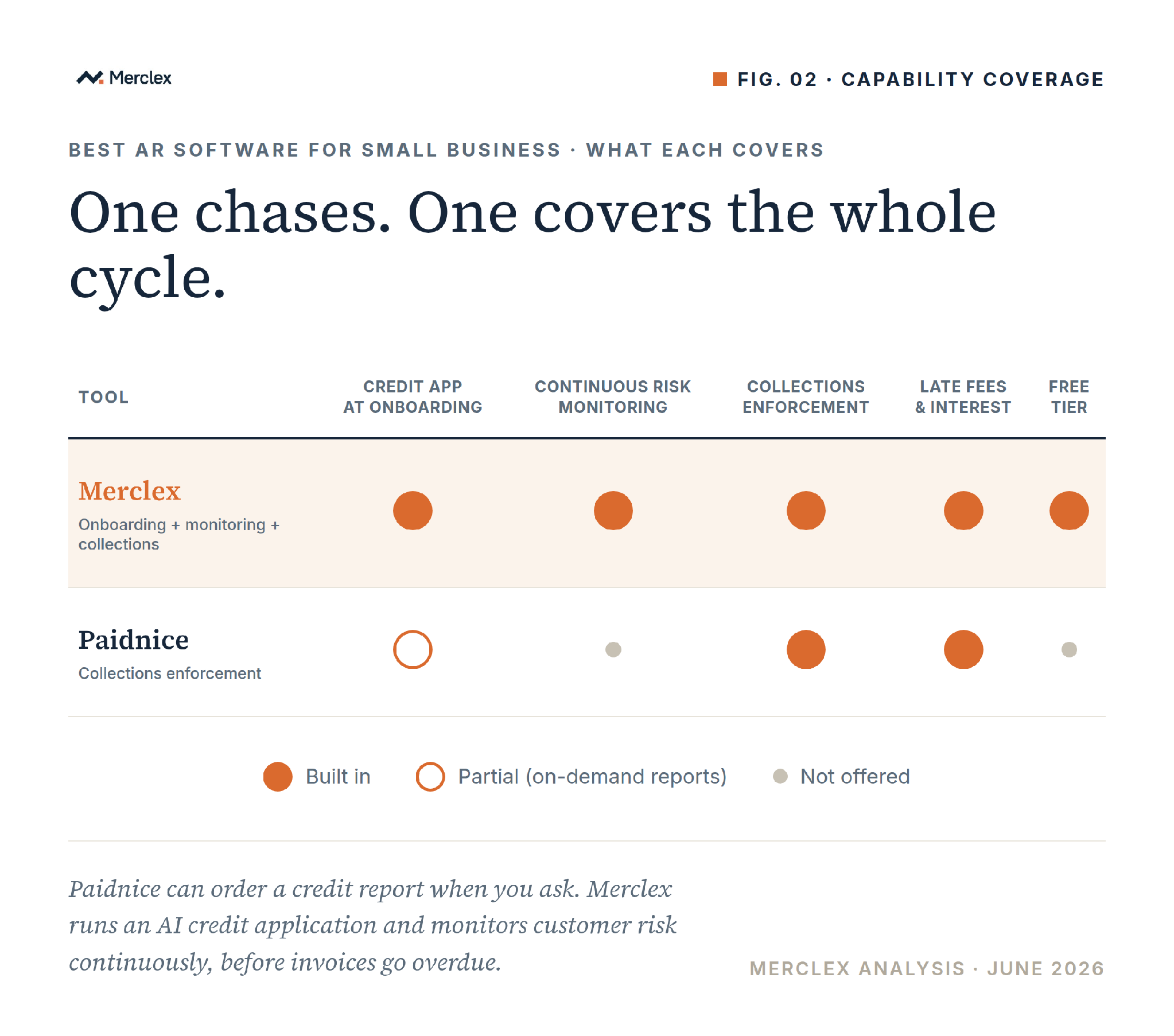
Paidnice can order a credit report when you ask. Merclex runs an AI credit application and monitors customer risk continuously, before invoices go overdue.
When Paidnice Is the Better Choice
Paidnice is the right pick when collections is genuinely your only problem. Reach for it if:
- You already screen your customers and rarely get surprised by who pays late.
- You want the deepest enforcement toolkit available: compounding interest, dispute letters, escalation by contact, and formal payment plans.
- You run on NetSuite or MYOB, where Paidnice has native integrations that Merclex does not.
- You want flat, predictable monthly pricing you can budget against at steady invoice volume.
When Merclex Is the Better Choice
Merclex is the right pick when late payment is downstream of a credit problem. Reach for it if:
- You extend terms to customers you do not know well and want to vet them before you sell.
- You have been burned by a customer who looked fine and then quietly stopped paying.
- You want one tool for onboarding, monitoring, and collections instead of stitching three together.
- You want to start free and prove the value before committing a budget.
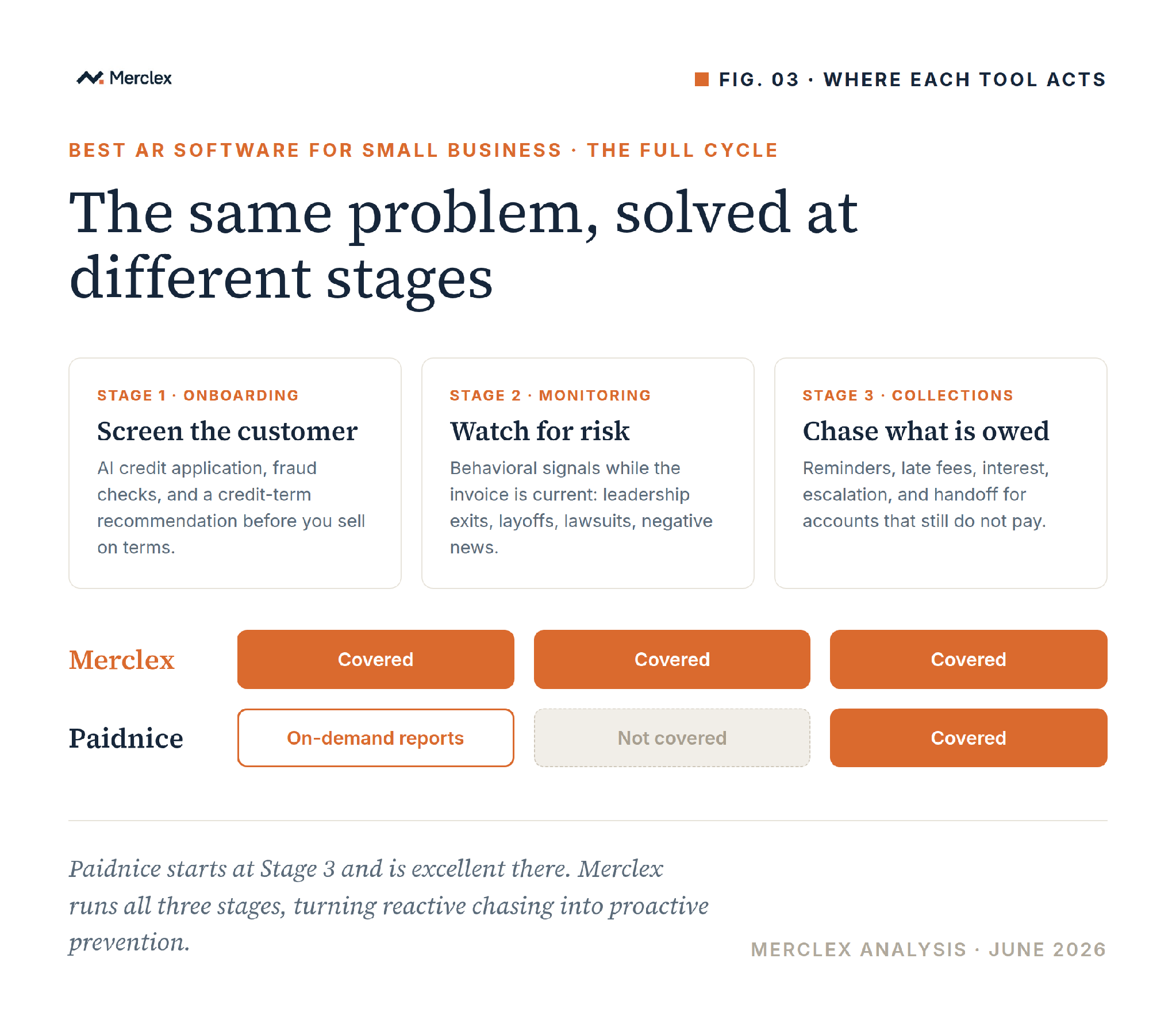
Paidnice starts at Stage 3 and is excellent there. Merclex runs all three stages, turning reactive chasing into proactive prevention.
Frequently Asked Questions: Merclex vs. Paidnice
Is Merclex or Paidnice better for small business?
It depends on your problem. Paidnice is better if you only need to automate collections and already vet your customers, and it offers the deepest enforcement toolkit on Xero and QuickBooks. Merclex is better if you extend credit to customers you do not know well and want to prevent bad debt by screening and monitoring them, not just chasing overdue invoices. Merclex also has a free starter tier.
How much do Merclex and Paidnice cost?
Paidnice starts at $69 per month for its Essentials plan, with Pro plans tiered by invoice volume at $99 and $179 per month and custom pricing above that. There are no revenue caps. Merclex has a free starter tier, with paid plans that scale as you use more.
Does Paidnice check customer credit?
Paidnice lets you order business and consumer credit reports on demand to inform a credit decision, and it offers risk scoring. It does not run an automated credit application at onboarding or monitor your customers continuously. Merclex automates the credit application and fraud checks at onboarding and then monitors each customer for risk while their invoices are still current.
Can Merclex and Paidnice both apply late fees?
Yes. Both automate late fees and interest. Paidnice has a deep rules engine for flat fees, percentage fees, and compounding interest with grace periods and variable rates. Merclex auto-calculates late fees as part of its collections automation and prioritizes the chase by customer risk.
Which one integrates with my accounting software?
Paidnice integrates with Xero, QuickBooks Online, QuickBooks Desktop, Sage Accounting, Sage Intacct, NetSuite, MYOB, and Stripe. Merclex connects to QuickBooks, Sage, and Xero. If you use QuickBooks or Xero, both work. If you use NetSuite or MYOB, Paidnice is the safer fit.
What does Merclex do that Paidnice does not?
Merclex screens new customers with an AI credit application and fraud checks before you extend terms, and monitors each customer for behavioral risk signals while their invoices are still current. That lets you prevent bad debt rather than only chasing it after an invoice goes overdue, which is where a collections-only tool starts.
The Bottom Line: Merclex vs. Paidnice
Paidnice is a genuinely excellent collections tool, and for a lot of small businesses it is the right answer. If you already know your customers and your only goal is to chase overdue invoices harder and smarter, its enforcement stack is deep, its pricing is predictable, and it earned its Xero award for good reason. Pick it with confidence if collections is the whole job.
But collections is the last stage of getting paid, not the only one. The customer who turns into bad debt rarely looks different from a normal late-payer until it is too late, and a tool that only acts on overdue invoices will always be reacting. Merclex screens customers at onboarding, monitors their risk while invoices are still current, and then prioritizes collections by who is actually most likely to default. For a small business extending real trade credit, that shift from reactive chasing to proactive prevention is the difference between getting paid late and not getting paid at all.