BOTTOM LINE
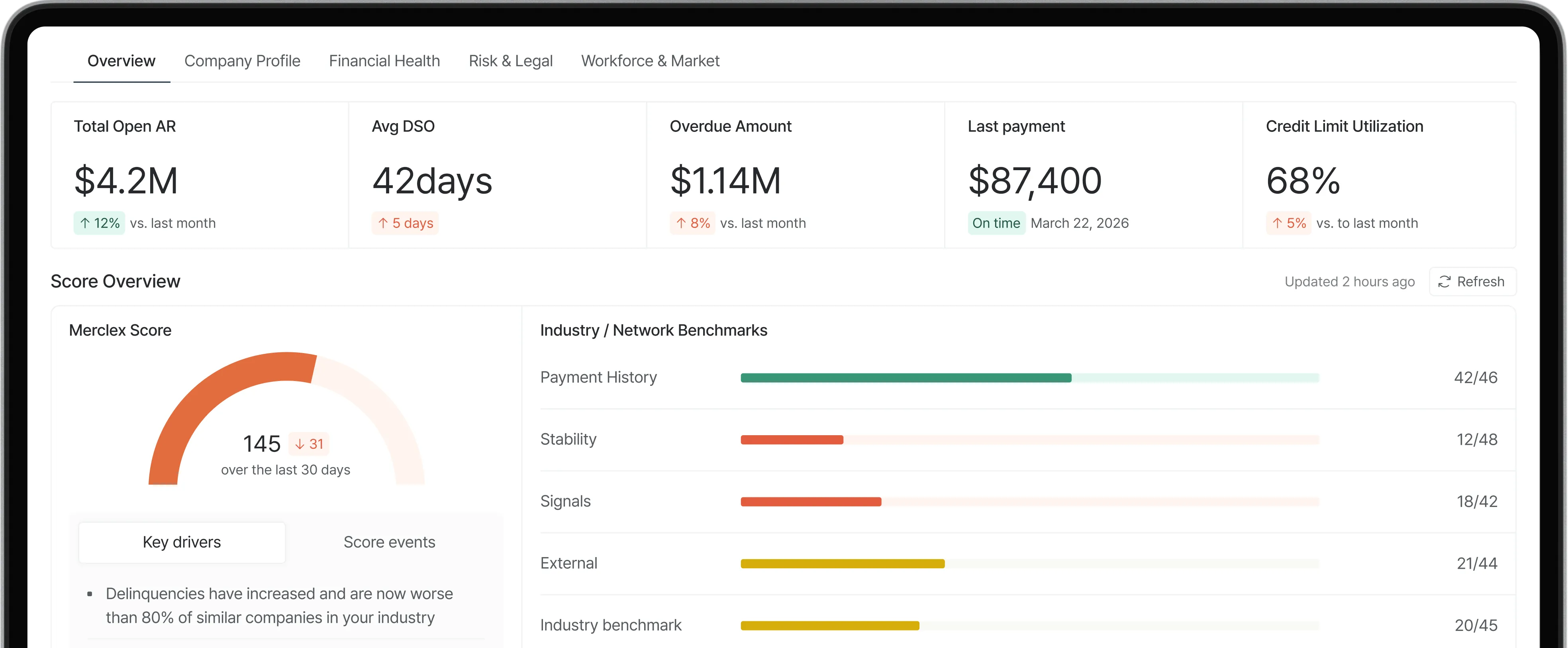
• B2B DSO commonly sits between 45 and 60 days, often higher than the stated payment terms. About half of US B2B invoices are paid late.
• Six levers move DSO reliably: tighter credit policy at onboarding, automated payment reminders, real-time risk monitoring, AI-prioritized collections, early-payment discounts, and faster invoicing.
• The biggest single lever is automated payment reminders. Industry research puts the impact at 12 to 18 days of DSO reduction versus manual chasing.
• DSO reduction compounds. Stacking three or four levers gives 20+ days back in most cases, which often translates to weeks of additional runway.
Direct Answer
B2B DSO can be reduced by combining six levers, each of which has a documented typical impact: tighter credit policy at onboarding (10 to 15 days, per the B2B Payments Innovation Report), automated payment reminders (12 to 18 days), real-time risk monitoring (6 to 10 days), AI-prioritized collections worklists (4 to 6 days, per HighRadius reported customer data), early-payment discounts like 2/10 Net 30, and same-day invoicing. Most businesses can stack three of these for measurable cash flow improvement within a quarter.
Context for what "normal" looks like: B2B DSO commonly sits between 45 and 60 days. About half of US B2B invoices are overdue and roughly 8% are written off as bad debt, per Centime's DSO guide. A reasonable practical threshold: act if DSO exceeds your stated payment terms by 50% or more, or if more than 20% of AR is aging past 60 days.
The honest framing: DSO reduction is mostly an operational discipline problem, not a software problem. Software helps, but only after you have decided which behaviors you want to enforce.
The Six Levers, Ranked by Typical Impact
Each lever below has a published industry source for the impact range. Stacking three or more typically yields 20+ days of DSO reduction.
Listed in order of typical impact. The math is simple: stack them.
1. Automated payment reminders
The single biggest mover. Manual chasing is inconsistent: invoices get missed, escalations slip, and the customers who pay loudest get more attention than the ones who silently age. Automated reminders fire on a defined cadence (typically 7 days before due, on the due date, then 3, 7, and 14 days past due) without anyone deciding to send them. Industry research puts the impact at 12 to 18 days of DSO reduction versus manual processes.
Source: Credit Pulse 2025 DSO benchmark
2. Tighten credit policy at onboarding
Most DSO problems start at the front of the funnel. A customer extended Net 30 without a credit check often pays in 50 to 60 days. A formalized credit policy (verified financials, payment history, credit reports, structured term recommendations) at onboarding cuts that gap. The B2B Payments Innovation Report documents 15 fewer DSO days for companies with formalized credit policies versus those without.
Source: 2022 B2B Payments Innovation Report
3. Real-time risk monitoring
Catch payment slowdowns before they become defaults. Real-time monitoring flags customers whose Days Beyond Terms (DBT) is creeping up, whose disputes are increasing, or whose external signals (LinkedIn headcount drops, news sentiment shifts) suggest stress. Intervention 60 days before a missed payment is far cheaper than collection after one. Credit Pulse benchmarks put the typical impact at 6 to 10 days of DSO reduction.
Source: Credit Pulse 2025 benchmark
4. AI-prioritized collections worklists
Most collections teams work top-down: oldest invoice first. AI-prioritized worklists rank accounts by likelihood of payment within the next 30 days, expected value, and ease of resolution. Same team, same hours, more cash collected. HighRadius reports customer data showing 4 to 6 days of DSO reduction from AI-prioritized worklists, with up to 20% DSO reduction from full automation in some deployments.
Source: HighRadius customer-reported outcomes
5. Early-payment discount (2/10 Net 30)
Offer a 2% discount for payment within 10 days on Net 30 terms. The customer's incentive is significant: 2% over 20 days is an effective ~36% annualized return on their cash. The cost to you is real but smaller than carrying the receivable. Best used selectively, on customers whose cost of capital is high enough to bite. Beancount.io's DSO analysis documents typical 3 to 8 days of DSO reduction when this is offered broadly.
Source: Beancount.io DSO analysis (April 2026)
6. Invoice faster (same-day)
Every day between work delivered and invoice sent is a day added to DSO. Some teams take a week to send invoices after the milestone is hit. Moving to same-day or next-business-day invoicing is the cheapest DSO lever to implement, requiring process change rather than software. Typical impact is 2 to 5 days. Larger if your current cadence is monthly batch invoicing rather than transactional.
Source: Best-practice baseline across multiple sources
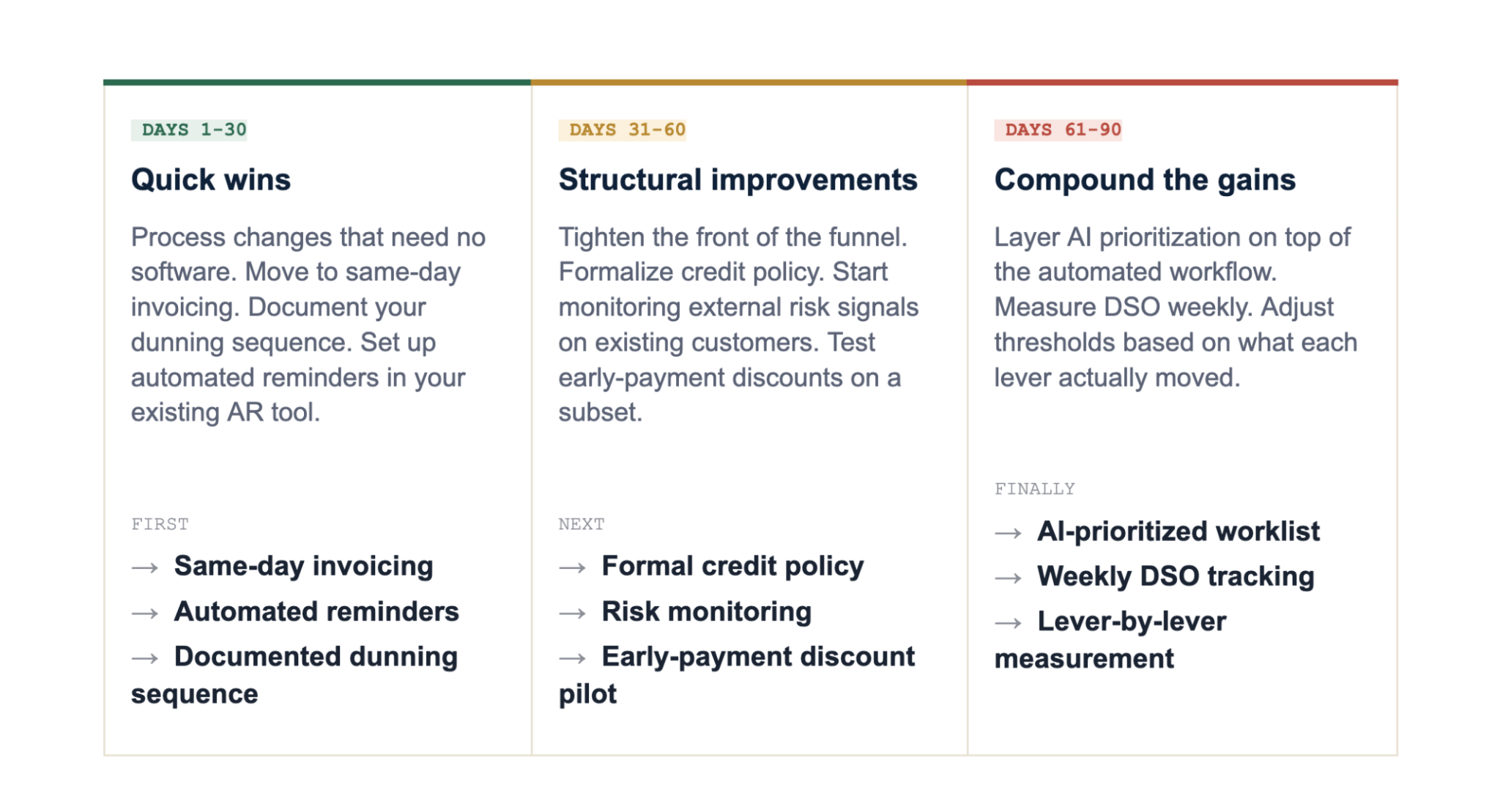
How to Sequence This in 90 Days
Implementation order matters. Do the cheap, fast levers first to build momentum, then the structural ones.
Common Mistakes
• Treating DSO as a collections problem only. Half the answer is at onboarding (who you extend credit to, on what terms) rather than at collections (how you chase what is already due).
• Skipping the measurement. If you do not track DSO weekly, you cannot tell which lever actually worked. Stacking changes without measurement is gambling, not improvement.
• Aggressive collections on the wrong accounts. Pushing hard on customers whose DSO is just normal for their industry damages relationships without moving the metric. Save aggressive collection energy for outliers.
• Offering early-payment discounts to everyone. The math only works on customers whose cost of capital makes the discount attractive. Offered broadly, it just gives away margin to customers who would have paid on time anyway.
• Buying software before fixing the process. A bad process automated is still a bad process, just faster. Decide the policy first, then automate it. Most teams that buy AR software without that step end up with a digitized version of their existing mess.
Frequently Asked Questions
What is a good DSO for a B2B business?
Context-dependent. For B2B businesses offering Net 30 terms, a DSO of 30 to 35 days is healthy. Net 60 terms typically yield DSO of 55 to 70 days. Industry matters: construction commonly runs 90 to 120 days due to progress billing and retainage, while SaaS averages 55 to 60 days. A practical alert threshold is DSO exceeding stated terms by 50% or more, or 20%+ of AR aging past 60 days.
How fast can DSO actually move?
Measurably within a quarter, if you stack levers. Credit Pulse benchmarks document 12 to 18 days of DSO reduction from automated reminders alone within 60 to 90 days of implementation. Larger reductions (20 to 30 days) require structural changes to credit policy or onboarding, which take longer to flow through to the AR ledger but are durable.
Does AR automation actually reduce DSO, or is it marketing?
It works, but the numbers vary by platform and starting point. HighRadius reports documented an average 10% DSO reduction across 1,300+ enterprises. Resolve's analysis documents up to 30% reduction in write-offs when AR automation is combined with predictive monitoring. Customer-specific results depend on starting DSO and the depth of automation.
What is the difference between DSO and Best Possible DSO (BPDSO)?
BPDSO is the DSO you would have if every invoice were paid exactly on the due date. It strips out delinquency. The gap between actual DSO and BPDSO measures pure collection performance. If your BPDSO is 28 (Net 30 terms, paid on time) but your actual DSO is 51, that 23-day gap is what collection process improvement can capture. If your BPDSO is already 60 (because your terms are Net 60), no collection improvement will get you below 60. Term changes would.
How do early-payment discounts affect DSO and margin?
A 2/10 Net 30 discount typically reduces DSO by 3 to 8 days when adopted across the customer base. The margin cost is real: 2% off invoice value. The trade-off math works when your cost of capital plus opportunity cost exceeds the 2% margin loss. For most growing businesses, that math works at the 2% level. It rarely works at 3% or higher.
Should I outsource collections to reduce DSO?
Generally no, except for severely past-due accounts (90+ days) where internal collection has failed. Outsourced collections costs 15 to 30 percent of recovered amounts and damages customer relationships. Better path: tighten the early stages so fewer accounts ever reach the collection agency tier. Reserve agencies for the small tail of genuinely uncollectible accounts.
What single thing should I do this week to start reducing DSO?
Two specific actions. One, audit the average gap between work delivery and invoice send for the last 30 days. If it is more than 24 hours, move that down. Two, set up automated payment reminders (pre-due, due-date, and 3/7/14 day past-due) if you do not already have them. Both are zero-software changes that move DSO measurably within 30 days.
Summary
• B2B DSO commonly sits between 45 and 60 days, often above stated payment terms. About half of US B2B invoices are overdue.
• Six levers move DSO reliably, with documented impact ranges. The biggest is automated payment reminders (12-18 days). Stacking three or four typically yields 20+ days of reduction.
• Sequence matters: process changes first, structural improvements next, AI prioritization last. Measure weekly to know what worked.