TL;DR: Chaser, Paidnice, and Merclex all automate invoice follow-up and assess credit risk. The difference is what kind of risk they catch.
- Chaser wins on personal, multi-channel chasing (email from your address, SMS, auto-calls). Volume-based pricing that climbs as you grow.
- Paidnice wins on flat-rate value: the full collections suite for $69/mo, no revenue caps, deep Xero/QuickBooks sync.
- Merclex takes a different angle on risk. It screens new customers for fraud and monitors external signals (negative news, headcount drops, leadership exits) that move before payment history does. Only one of the three with a permanently free tier.
Chaser vs Paidnice vs Merclex: Which Invoice Follow-Up Tool Is Right for Your Small Business?
An honest comparison of Chaser, Paidnice, and Merclex for small business invoice follow-up. Where each one wins on price, reminders, and integrations, and the one question that decides between them.
If you've narrowed your search for invoice follow-up software down to Chaser, Paidnice, and Merclex, you've already done the hard part.
All three automate the soul-crushing work of chasing overdue invoices, and any of them will beat doing it by hand. The question isn't which is best in the abstract, it's which is right for your small business specifically.
It's worth getting this decision right. 92% of businesses still get paid late, and US small businesses are owed more than $17,000 each on average in unpaid invoices. Automating follow-up genuinely moves the needle: businesses that use accounts receivable automation are 52% more likely to be paid within two weeks, and most teams cut their days sales outstanding by 10 to 20 days. The right tool pays for itself quickly. The wrong one just adds a subscription.
Here's the short version of how these three differ. All three do more than chase, and all three assess credit risk in some form. Chaser leads on personal, multi-channel chasing and predicts late payment from a customer's history and credit-bureau data. Paidnice is the best flat-rate value for full collections, and it can pull credit reports and risk scores too. Merclex takes a different angle on risk: it screens new customers for fraud and monitors external signals like negative news and headcount changes that move before payment history does, and it's the only one of the three with a free tier. This guide compares all three honestly, dimension by dimension, so you can pick the one that fits how you actually work.
The Quick Verdict
Choose Chaser if personal, relationship-preserving chasing matters most. Its reminders come from your own email address, and it adds SMS and automated phone calls on top, with AI-drafted replies and call logging. It's far more than a reminder tool, too: it runs credit checks, rates each customer as a good, average, or bad payer, and predicts which invoices will be paid late. The tradeoff is pricing that scales with your volume and can climb.
Choose Paidnice if you want the complete collections toolkit at a flat, predictable price. For $69 per month with no revenue caps, you get reminders, a late-fee rules engine, statements, payment plans, escalations, and a customer portal, plus credit reports and risk scoring you can order in-app, with deep two-way Xero and QuickBooks sync and setup in about 30 minutes. It's the best value for a full collections and credit-control suite.
Choose Merclex if you want a different angle on risk than the other two. All three assess credit risk, but Chaser and Paidnice lean on credit-bureau data and payment history. Merclex adds fraud and identity screening for brand-new customers (EIN, sanctions, domain, and address checks) and monitors external signals like negative news, headcount drops, and leadership departures, the kind of trouble that surfaces before it ever reaches payment history. It's also the only one of the three with a genuinely free tier. If your worry is the new customer you can't vouch for, or the one who pays perfectly until their business suddenly fails, Merclex is built for that.
Chaser vs Paidnice vs Merclex at a Glance
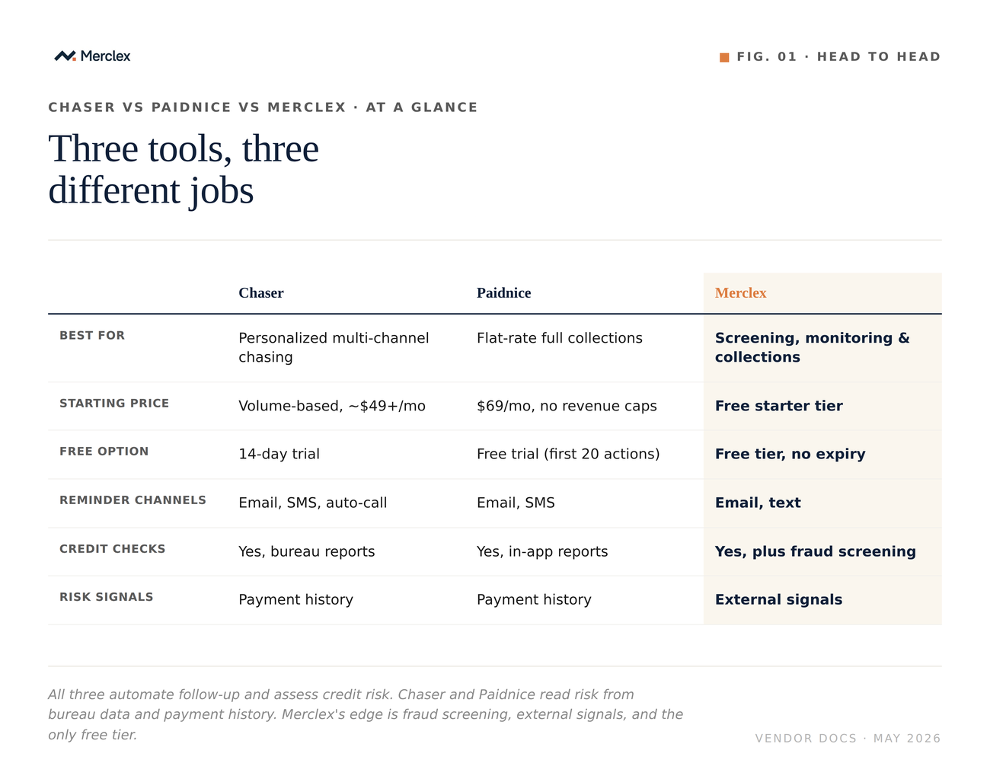
The table below puts the three invoice follow-up tools side by side on the factors that decide most small business choices. Detailed comparisons follow.
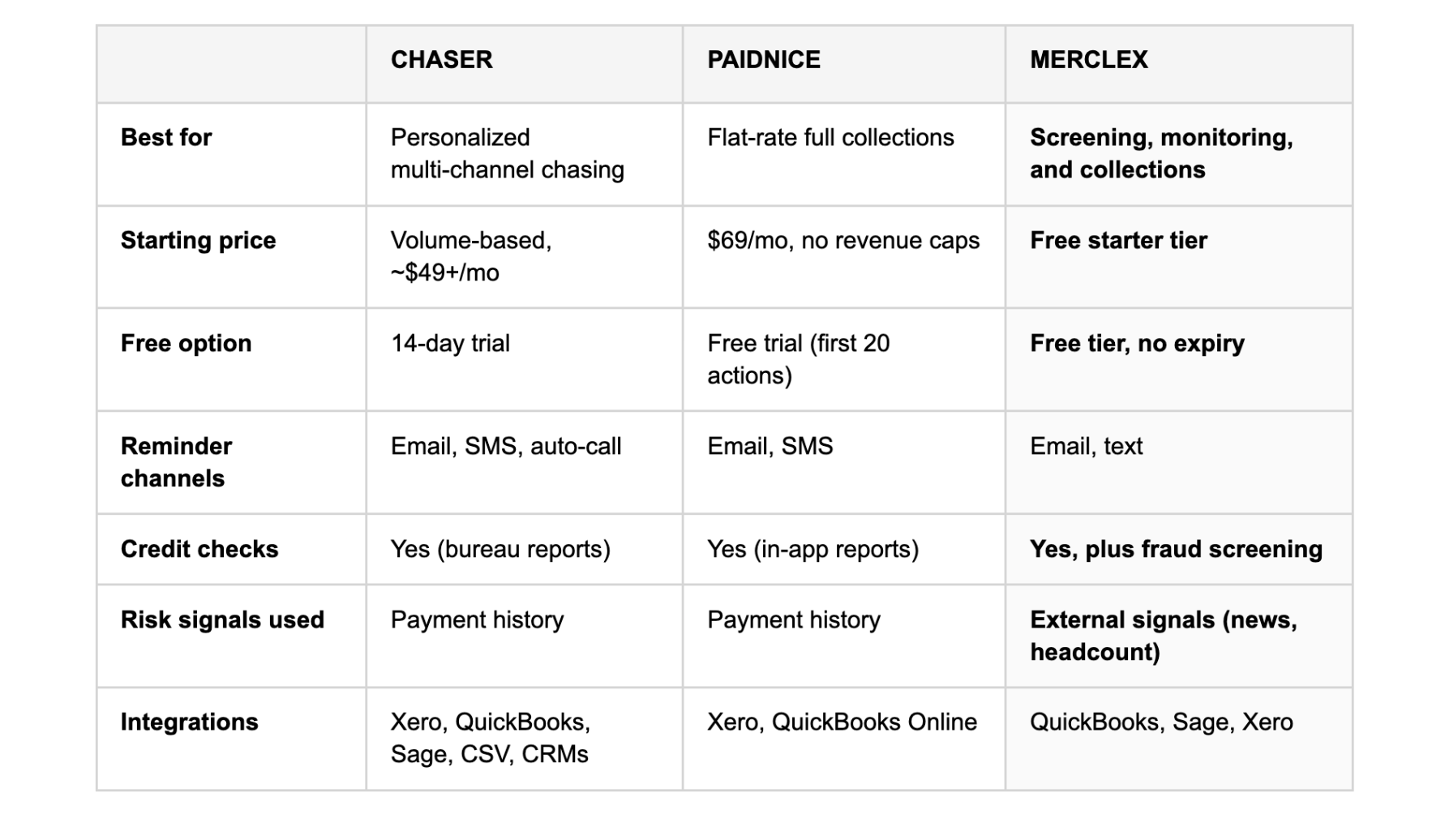
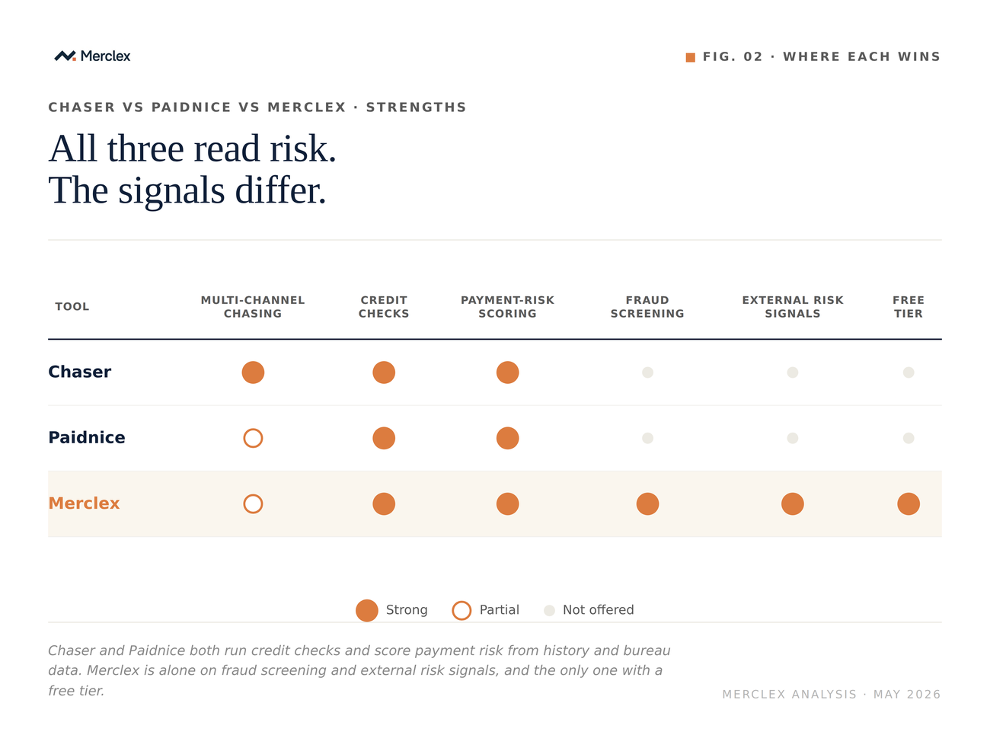
All three automate follow-up and assess credit risk. Chaser leads on personalized multi-channel chasing, Paidnice on flat-rate value. Merclex's edge is fraud screening and external risk signals, plus the only free tier.
Meet the Three Tools
Chaser
Chaser is a UK-based accounts receivable platform that has been around since 2014, making it the most established of the three. Its whole philosophy is that chasing should feel human. Reminders go out from your own email address with your signature and branding, so customers receive what reads like a personal note. On top of that, Chaser layers SMS reminders, automated phone calls, AI-drafted replies in your tone, and full call logging. It integrates with Xero, QuickBooks, and Sage, supports CSV import for other systems, and connects to CRMs like HubSpot and Salesforce, and it handles multiple currencies and languages for international customers. Chaser is also more than a chasing tool on the risk side: it runs credit checks that pull bureau reports and scores, applies a Payer Rating that labels customers as good, average, or bad payers, and uses a machine-learning Late Payment Predictor that scores how likely each invoice is to be paid late.
Paidnice
Paidnice is a modern collections platform built for businesses on Xero and QuickBooks Online, and it was named the 2025 Xero Global Small Business App of the Year. It covers the full collections workflow: automated reminders, a late-fee rules engine that can apply different fee structures to different customer segments, statements, payment plans, escalations, a customer payment portal, and AR reporting. It can also order credit reports and risk scores from inside the app and supports risk-based payment terms and credit-limit management. Its two-way accounting sync is deep, posting invoices, payments, credit notes, and late fees back in real time, and it advertises setup in about 30 minutes. Pricing is a flat $69 per month with no revenue caps, so cost scales with invoice volume rather than how much you earn.
Merclex
Merclex is a credit and collections platform that approaches risk from a different angle than the other two. Chaser and Paidnice assess risk mainly through credit-bureau data and a customer's payment history; Merclex adds two things they don't. Before you even send the first invoice, it screens new customers with an AI credit application and fraud checks (EIN lookup, OFAC and sanctions screening, domain age and reputation, and address matching), which matter most for a customer with no track record yet. While invoices are current, it monitors each customer for external behavioral signals like leadership departures, headcount drops, negative news, and lawsuits, the kind of real-world trouble that shows up before a customer's payment history changes. Then it automates collections with personalized email and text sequences, auto-calculated late fees, and one-click handoff to a collection agency. It connects to QuickBooks, Sage, and Xero, and the starter tier is free.
All three assess credit risk. Chaser and Paidnice read it from bureau data and payment history; Merclex adds fraud screening and external signals like news and headcount, and is the only one with a free tier.
Chaser vs Paidnice vs Merclex, Dimension by Dimension
Pricing and Value
This is where the three diverge most. Chaser uses volume-based pricing that scales with your needs, with third-party listings putting it roughly in the $49 to $369 per month range; its pricing leans more enterprise as you grow. Paidnice is a flat $69 per month with no revenue caps, which makes it the most predictable and often the best value for a growing small business. Merclex starts free, with paid plans that scale as you use more. For pure budget predictability, Paidnice wins; for starting at zero cost, Merclex does.
Reminders and Personalization
All three send automated reminders, but the texture differs. Chaser is the leader here: reminders from your own email, plus SMS, automated phone calls, and AI-drafted replies make it the richest, most personal chasing experience. Paidnice sends polished reminders and SMS with a strong rules engine behind them. Merclex sends personalized email and text sequences and adds behavior-based nudges tied to a customer's payment reputation. If your priority is the most human, multi-channel outreach, Chaser leads.
Integrations
Chaser has the broadest integration list: Xero, QuickBooks, and Sage, plus CSV import and CRM connections to tools like HubSpot and Salesforce. Paidnice focuses its depth on Xero and QuickBooks Online with a genuinely thorough two-way sync. Merclex connects to QuickBooks, Sage, and Xero. If you need CRM connections or run on Sage, Chaser is the most flexible; if you live in Xero or QuickBooks and want the deepest sync, Paidnice is excellent.
What's Free
Chaser and Paidnice both offer free trials rather than free plans: Chaser a 14-day trial, Paidnice a trial covering your first 20 invoice actions with no card required. Merclex is the only one with a genuinely free tier that doesn't expire, which lets you run real collections (and screening and monitoring) at no cost before deciding whether to upgrade. If a permanently free option matters, only Merclex offers one.
Credit Risk and Monitoring
All three of these tools assess credit risk, which is worth clearing up because it is often misunderstood. Chaser runs credit checks that pull bureau reports and scores, rates each customer as a good, average, or bad payer, and uses a machine-learning Late Payment Predictor to flag which invoices are likely to be paid late. Paidnice can order credit reports and risk scores from inside the app and supports risk-based terms and credit limits. So the real question is not whether a tool assesses risk, it is what kind of risk it sees. Chaser and Paidnice both work primarily from credit-bureau data and a customer's payment history, which is powerful for a customer who already has a track record with you. Merclex looks at two things they don't: fraud and identity signals at onboarding, useful for a brand-new customer with no history, and external behavioral signals like negative news, headcount drops, and leadership departures, which often move before a customer's payment behavior does. In practice, Chaser and Paidnice are strongest at telling you who has paid late before. Merclex is built to catch the customer who looks fine on paper but whose business is quietly failing, and to vet customers you have never dealt with.
There's no single winner, only the right fit. Pick on what you actually need: richer chasing, flatter pricing, or a different lens on risk for new and unknown customers.
How to Choose Between Them
The cleanest way to decide is to name your real bottleneck, then match it to the tool built for it.
• If your bottleneck is getting reminders read and keeping relationships warm: choose Chaser. Multi-channel, personal-feeling outreach is its core strength, and few tools chase as humanely.
• If your bottleneck is cost and you want everything for one flat price: choose Paidnice. The full collections suite at $69 per month with no revenue caps is hard to beat on value, especially on Xero or QuickBooks.
• If your bottleneck is new customers you can't vouch for, or ones who fail without warning: choose Merclex. Its fraud screening and external risk monitoring catch what bureau data and payment history miss, and you can start for free.
Many small businesses will find the decision comes down to the kind of risk they face. All three help you collect faster and flag risky accounts. Chaser and Paidnice read risk from payment history and bureau data; Merclex adds fraud screening for unknown customers and external signals for ones whose business is turning. The right choice depends on whether your losses come from customers who pay late, or from ones you never should have shipped to in the first place.
Frequently Asked Questions
Is Chaser or Paidnice better for a small business?
It depends on your priority. Chaser is better if you want the most personal, multi-channel chasing (email, SMS, and automated phone calls) and broad integrations including Sage and CRMs. Paidnice is better if you want the full collections suite at a flat, predictable $69 per month with no revenue caps and you run on Xero or QuickBooks. Paidnice usually wins on value; Chaser wins on communication depth.
How is Merclex different from Chaser and Paidnice?
All three do more than chase, and all three assess credit risk, so the difference is in approach. Chaser and Paidnice read risk from credit-bureau reports and a customer's payment history (Chaser adds a Payer Rating and a Late Payment Predictor; Paidnice offers in-app credit reports and risk scoring). Merclex adds what they don't: fraud and identity screening for brand-new customers, and monitoring of external signals like news, headcount, and leadership changes that surface trouble before payment history does. Merclex is also the only one of the three with a permanently free tier.
Which invoice follow-up tool is cheapest?
Merclex has a genuinely free starter tier, so it's the cheapest way to start. Among paid options, Paidnice is the most predictable at a flat $69 per month with no revenue caps. Chaser's volume-based pricing starts lower on paper (third-party listings from around $49) but can climb as you scale. Chaser and Paidnice both offer free trials rather than free plans.
Do Chaser, Paidnice, and Merclex integrate with QuickBooks and Xero?
Yes, all three. Chaser integrates with Xero, QuickBooks, and Sage, plus CSV import and CRMs. Paidnice offers deep two-way sync with Xero and QuickBooks Online specifically. Merclex connects with QuickBooks, Sage, and Xero. If you need Sage or CRM connections, Chaser is the most flexible; if you want the deepest Xero or QuickBooks sync, Paidnice is excellent.
Can these tools tell me which customers won't pay?
All three offer some risk insight. Chaser's Late Payment Predictor and Payer Rating estimate who will pay late based on payment history, and both Chaser and Paidnice can pull credit reports. Merclex approaches it differently, screening new customers for fraud and monitoring external signals like leadership departures, headcount drops, negative news, and lawsuits, so you can catch a customer heading toward default even when their payment history still looks clean.
Which should I choose for invoice follow-up?
Pick Chaser for the richest personal, multi-channel chasing; Paidnice for the best flat-rate value on Xero or QuickBooks; and Merclex if you want fraud screening for new customers and external risk monitoring on top of collections, plus a free tier. All three assess credit risk, so match the tool to the kind of risk you face rather than to a feature count.
The Bottom Line
There's no single winner here, only the right fit for your situation. Chaser is the choice for personal, multi-channel chasing and broad integrations. Paidnice is the choice for complete collections at a flat, predictable price on Xero or QuickBooks. Both are excellent at what they do, which is getting overdue invoices paid faster.
Merclex is the choice when you want a different lens on risk. All three assess credit risk, but Chaser and Paidnice work from bureau data and payment history. Merclex adds fraud and identity screening for new customers and monitors external signals, like news, headcount, and leadership changes, that move before payment history does, all from a free starting tier. If your losses come from customers you can't vouch for, or ones who look fine until they suddenly fail, that difference is the whole decision. Start free, connect your accounting software, and see the risk the other tools can't.