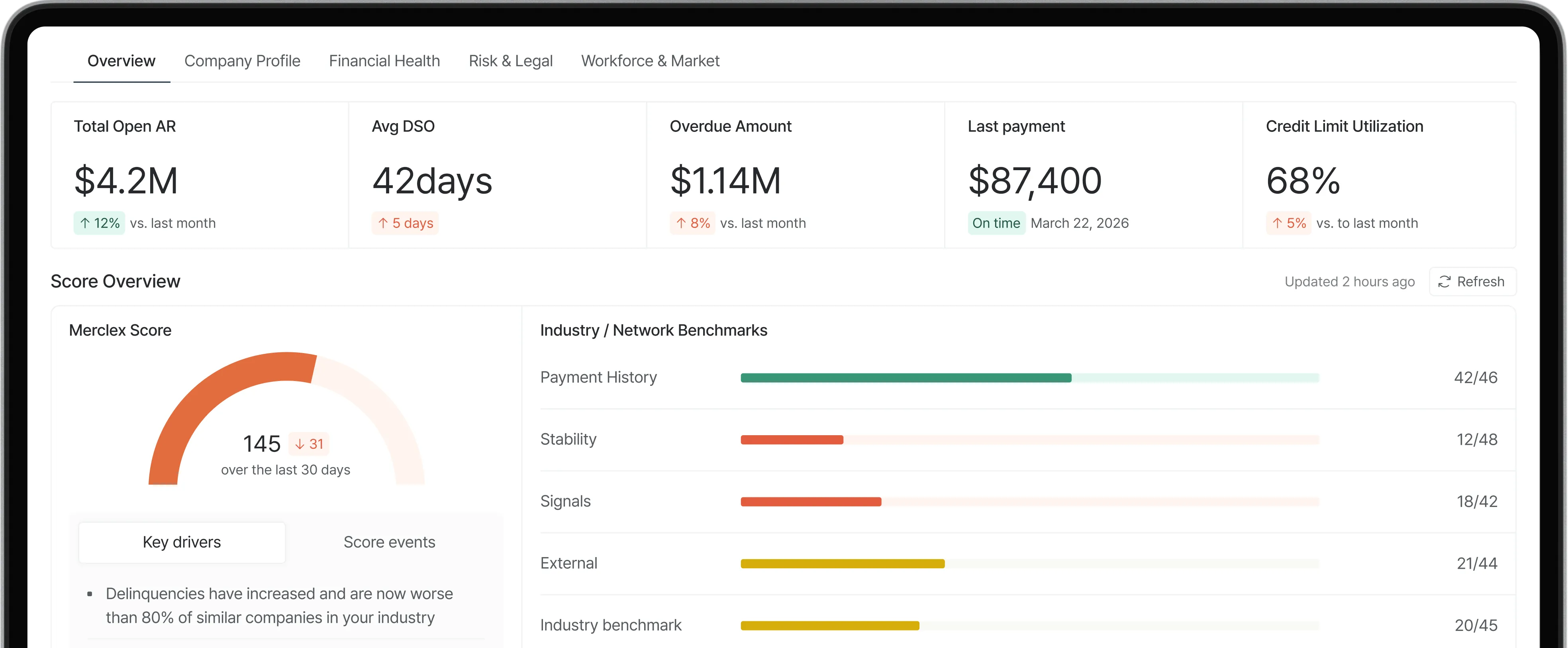
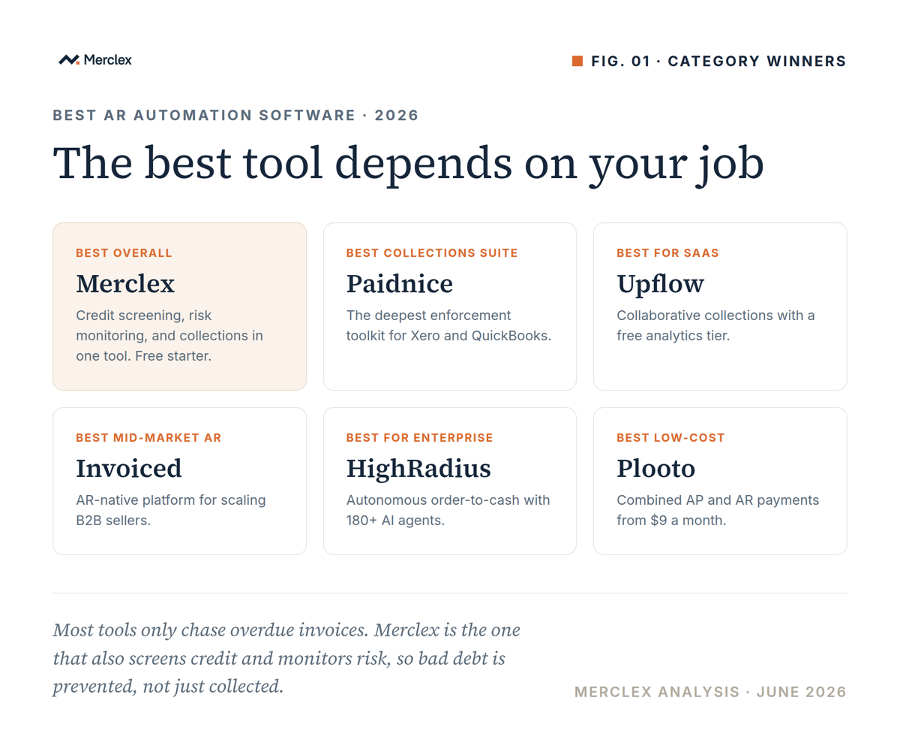
- Merclex is the best overall AR automation software in 2026 because it is the only tool that screens customer credit, monitors risk, and automates collections in one place, with a free starter tier.
- Paidnice is the best collections suite for Xero and QuickBooks.
- Upflow is best for SaaS teams, Invoiced for scaling mid-market AR, and HighRadius for enterprise order-to-cash.
- Pick on your real problem: chase overdue invoices, or prevent the bad debt before it starts.
Accounts receivable is where revenue quietly leaks. More than half of US B2B invoiced sales are now overdue, days sales outstanding (DSO) in the US averages around 47 days, and a 10-day rise in DSO can cut your available cash by as much as 15%. Worse, roughly 6% of B2B credit sales never get paid at all and become bad debt write-offs. AR automation software exists to stop that leak, and in 2026 there are more options than ever, from $9-a-month tools to enterprise suites that cost six figures.
That range is exactly why buying is hard. A tool built for a SaaS startup chasing fifty invoices a month is useless to a manufacturer running thousands through SAP, and the reverse is true too. So this guide ranks the best AR automation software by who it is actually for, breaks down what each one does, and gives you a clear way to choose.
One thing to understand before you shop, because it decides how much cash you keep. Most AR tools only work after an invoice is already overdue. They chase. The better question is not how hard a tool chases, but whether it stops you from extending credit to a customer who was never going to pay. The best AR automation in 2026 does both: it screens credit at onboarding, watches customer risk while invoices are still current, and then collects. That distinction runs through every pick below.
How We Picked the Best AR Automation Software
We evaluated platforms across the whole accounts receivable market on five things: how much of the credit-to-cash cycle each one covers, how well it fits a specific company size, pricing transparency, the accounting systems and ERPs it connects to, and whether it prevents bad debt or only chases it after the fact. Tools that do one job well still earned a place when they are the best at that job. The result is twelve picks across three tiers: small business, mid-market, and enterprise.
Best AR Automation Software at a Glance
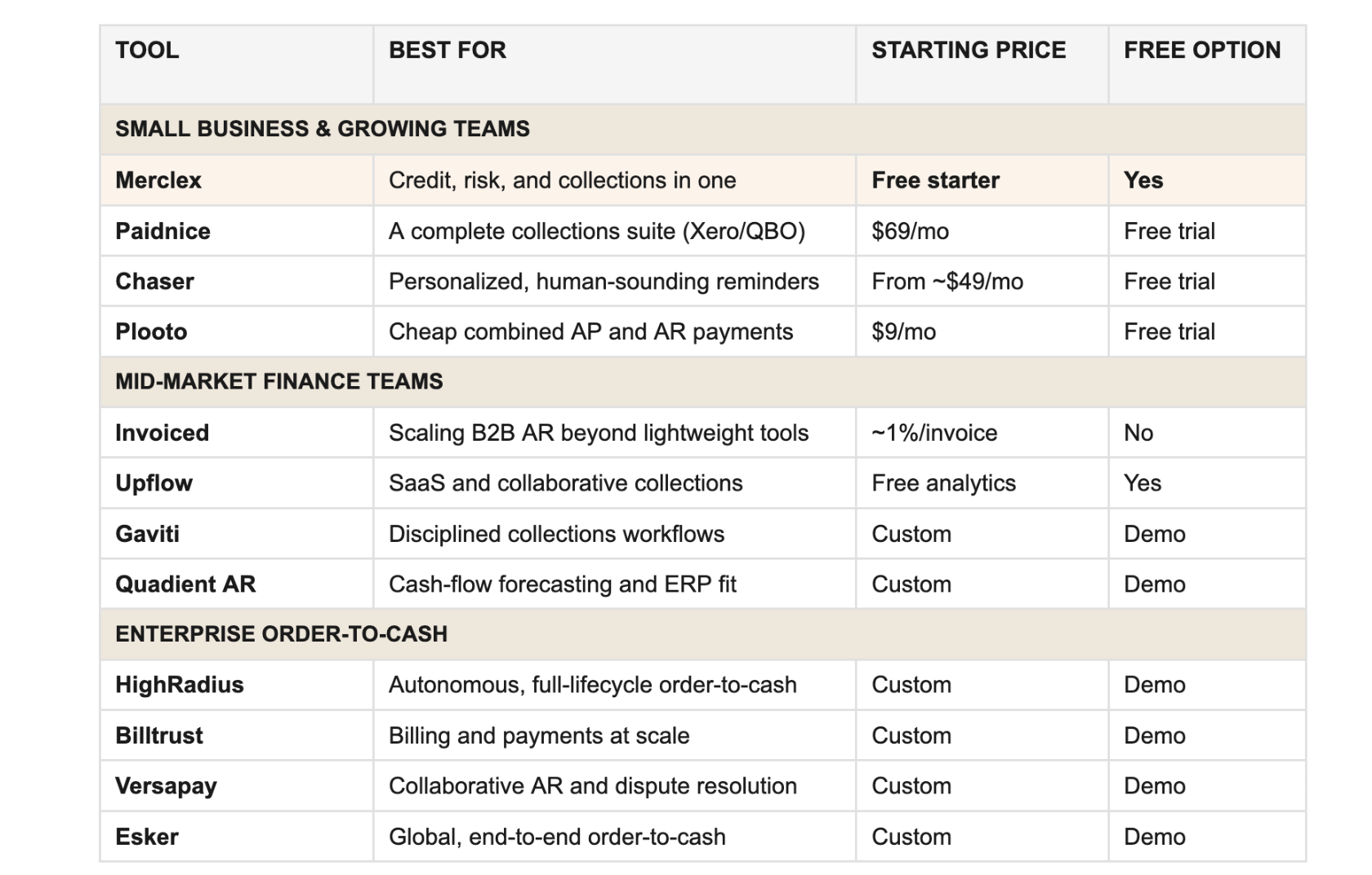
Here are the twelve tools, grouped by who they fit best. Full reviews follow, then a buyer's guide to choosing.
Best AR Automation Software for Small Businesses and Growing Teams
If you run on QuickBooks or Xero and a person on your team is chasing invoices by hand, this tier is where you start. These tools are affordable, quick to set up, and built for businesses without a dedicated AR department.
Merclex: Best Overall
At a glance: The only AR tool that screens customers at onboarding, monitors their risk, and automates collections, with a free starter tier.
Best for: B2B businesses that extend trade credit and want to prevent bad debt, not just chase it.
Pricing: Free starter tier; paid plans scale with usage.
Most AR software begins working once an invoice is already overdue. Merclex starts earlier and keeps going. At onboarding it runs an AI credit application with built-in fraud checks (EIN lookup, OFAC and sanctions screening, and domain and address verification) and recommends credit terms. While an invoice is still current, it monitors each customer for behavioral risk signals like leadership departures, headcount drops, negative news, earnings misses, lawsuits, and liens, scored by how much that customer matters to your book. Then it automates collections with personalized email and text sequences, auto-calculated late fees, and one-click handoff to a collection agency. It connects to QuickBooks, Xero, and Sage, and the starter tier is free.
It ranks first because it is the only tool here that brings credit screening, risk monitoring, and collections into one place at a price a small or mid-market team can actually start with. The enterprise suites do all of this too, but they cost six figures and take months to deploy. Merclex puts the same prevent-then-collect approach within reach of a business that is still running AR on spreadsheets and reminder emails.
Paidnice
A collections suite for Xero and QuickBooks, and the best value for pure collections.
Best for: SMBs on Xero or QuickBooks Online that want complete collections enforcement at a flat price.
Pricing: From $69/mo (Essentials); Pro tiers run $99 to $179 by invoice volume.
Paidnice was named the 2025 Xero Global Small Business App of the Year, and since 2022 it has processed on-time payments across more than $4 billion in transactions, cutting customer DSO by an average of 25%. It gives you the full enforcement stack: automated email and SMS reminders, a rules engine for late fees and compounding interest, escalation workflows, dispute letters, payment plans, and a self-service payment portal. Watch for: it chases brilliantly, but it does not screen customers at onboarding or monitor their risk while invoices are current.
Chaser
Collections built around personalized, human-sounding reminders sent from your own email.
Best for: Teams where preserving the customer relationship matters as much as getting paid.
Pricing: From about $49/mo; free trial.
Chaser sends reminders from your own email address with your own signature, so customers get what reads like a personal note rather than a generic platform alert. It supports multi-channel follow-ups and integrates with Xero and QuickBooks, and users report getting paid around 16 days sooner. Watch for: lighter reporting and customization, no NetSuite integration, and like the rest of this group, it acts on overdue invoices rather than warning you which customers are about to become a problem.
Plooto
Affordable combined AP and AR payment automation.
Best for: Cost-conscious SMBs that want to automate both payables and receivables cheaply.
Pricing: From $9/mo; per-transaction fees apply.
Plooto combines AP and AR payment automation in one tool starting at $9 a month, the lowest entry price here. It handles approvals, scheduling, and reconciliation, and gives customers ACH and card payment options. Watch for: it is payment-workflow first, so its collections features are lighter than a dedicated tool, it leans North American, and it carries no credit screening or risk monitoring.
Best AR Automation Software for Mid-Market Finance Teams
Once you have a finance team, real invoice volume, and customers who expect a polished payment experience, lightweight collections tools start to strain. This tier adds depth: cash application, forecasting, and structured collections at scale.
Invoiced
An AR-native platform for B2B sellers scaling past lightweight tools.
Best for: Growing mid-market teams that need real AR without an enterprise implementation.
Pricing: Advanced A/R is roughly 1% per invoice; Enterprise is custom.
Invoiced covers automated invoicing, Smart Chasing for personalized collections, a self-service buyer portal, and AI-powered cash application that reconciles incoming payments automatically. It delivers invoices across 260-plus AP portals, which is what selling to larger customers on procurement networks actually requires. Watch for: pay-as-you-go pricing near 1% per invoice adds up at high volume, and it does not screen buyer credit at onboarding.
Upflow
Collaborative collections with strong analytics, popular with SaaS.
Best for: SaaS and tech-forward teams that want finance, sales, and CS aligned on collections.
Pricing: Free analytics tier; paid plans are quote-based (reported from around $440/mo).
Upflow treats collecting payment as a customer-experience problem. Its free analytics tier lets you track DSO and aging before you pay, and paid plans add dunning across email and Slack, a payment portal, and shared timelines for sales and account managers. It integrates with Stripe, QuickBooks, Xero, and NetSuite. Watch for: quote-based pricing can climb as you grow, and it focuses on collections rather than credit onboarding.
Gaviti
A focused collections workflow and analytics platform.
Best for: Mid-market AR teams that want disciplined, repeatable collections processes.
Pricing: Custom quote; book a demo.
Gaviti brings structure to collections with automated reminder workflows, dispute management, promise-to-pay tracking, and cash-flow analytics, plus integrations into common ERPs. It is strongest when your real problem is process chaos and inconsistent follow-up. Watch for: it is a collections platform, not a credit-screening tool, and pricing is quote-based rather than published.
Quadient AR
Full AR automation with strong cash-flow forecasting, formerly YayPay.
Best for: Mid-market teams that prioritize forecasting and broad ERP compatibility.
Pricing: Custom quote; book a demo.
Quadient AR automates the AR workflow end to end and is known for cash-flow forecasting that the vendor reports at around 94% accuracy, alongside a self-service customer portal and wide ERP support. Watch for: it is not a payment facilitator, so payment acceptance can stretch implementation, and some users find the reporting and dashboards less intuitive than rivals.
Best AR Automation Software for Enterprise
At enterprise scale, AR becomes order-to-cash: credit, e-invoicing, cash application, collections, deductions, and payments across complex ERP environments. These platforms are powerful and priced for finance departments, not founders. Expect custom quotes and multi-week implementations.
HighRadius
Enterprise-scale autonomous order-to-cash.
Best for: Large finance teams running credit, billing, cash application, and collections in-house.
Pricing: Custom enterprise pricing.
HighRadius runs its Autonomous Receivables platform on 180-plus specialized AI agents and its FreedaGPT assistant, achieving 95%-plus straight-through cash application, meaning most payments match to invoices with no human touch. It serves 800-plus enterprises and covers the full lifecycle including credit and deductions. Watch for: enterprise pricing and implementation, and support that some customers note slows at peak times.
Billtrust
A broad invoice-to-cash platform with embedded payments and a payment network.
Best for: Enterprises standardizing billing and payment acceptance at scale.
Pricing: Custom enterprise pricing.
Billtrust spans invoicing, payments, and cash application with generative AI, processes more than $1 trillion in transactions annually, and runs a payment network that standardizes data exchange across thousands of buyers. Watch for: it is billing and payments led, so credit and servicing ownership stay with you, and implementations typically run six to twelve weeks.
Versapay
Collaborative AR built around shared buyer-seller portals.
Best for: Larger teams where disputes and customer confusion are the real cause of slow payment.
Pricing: Custom enterprise pricing.
Versapay covers the invoice-to-cash cycle and adds a collaborative portal where buyers and sellers view invoices, flag disputes, and exchange messages in one shared workspace, with embedded payments. It shines when DSO is driven by disputes and back-and-forth rather than simple forgetfulness. Watch for: the portal model is its strength, but it relies more on that shared workflow than on autonomous chasing.
Esker
Global, AI-driven order-to-cash from order entry through collection.
Best for: Global enterprises that want end-to-end order-to-cash in a single suite.
Pricing: Custom enterprise pricing.
Esker covers the full order-to-cash cycle, with AI models that learn which collection strategies work for which customer segments and strong support for multi-entity, multi-currency operations. Watch for: it is a broad enterprise suite, so the scope and cost are far more than a small or mid-market team needs.
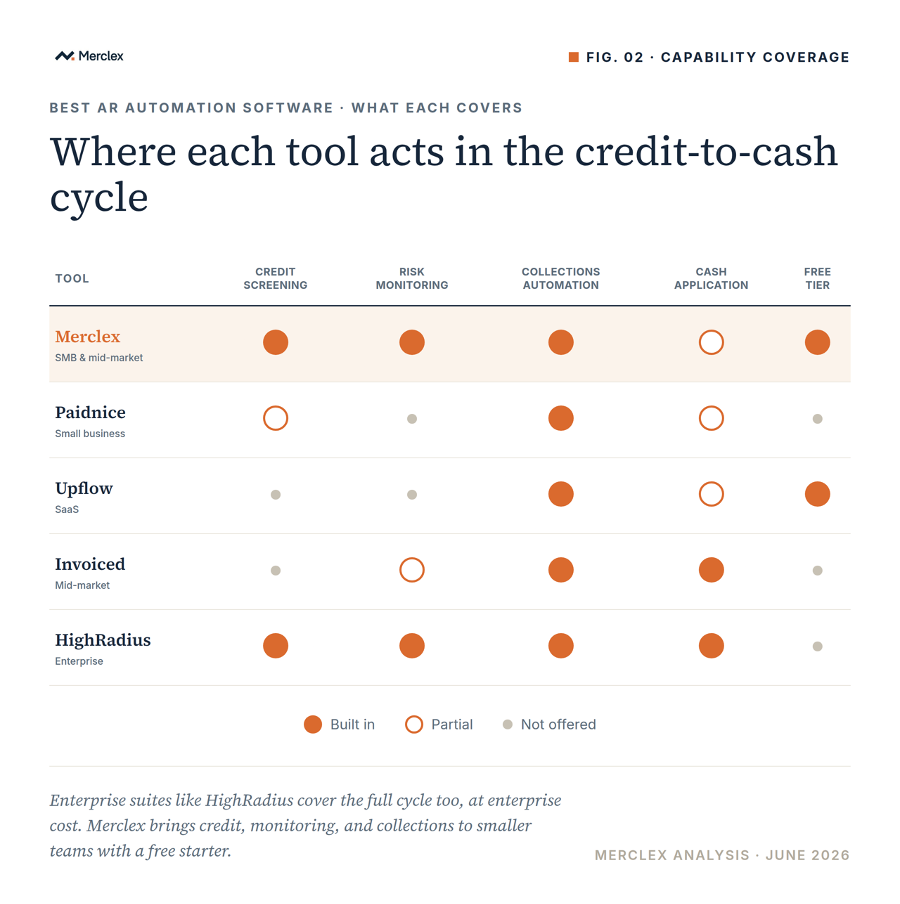
Where each tool acts across the cycle. The accessible tools mostly chase and apply cash; enterprise suites cover credit too, but at enterprise cost. Merclex brings the full cycle to smaller teams.
How to Choose AR Automation Software
The right tool is the one that matches your real problem, your size, and your stack. Five questions get you most of the way to a decision.
What Does AR Automation Software Actually Do?
AR automation software handles the repetitive work of getting paid: sending invoice reminders, applying late fees and interest, offering payment options, reconciling incoming payments to invoices (cash application), and tracking who is overdue. The more advanced platforms add cash-flow forecasting, and a small number also screen customer credit and monitor risk before invoices go late. The goal is the same across all of them: get paid faster, with less manual effort, and lose less to bad debt.
How Do You Match the Tool to Your Company Size?
Size is the single best filter. If you are a small business on QuickBooks or Xero, start with the first tier, where setup is fast and pricing is flat or free. If you have a finance team and real volume, the mid-market tier adds cash application, forecasting, and structured collections. If you are an enterprise running SAP, Oracle, or NetSuite with thousands of invoices, only the enterprise suites will keep up, and you should expect a real implementation project. Buying up or down a tier is the most common and most expensive mistake.
Does It Integrate With Your Accounting System or ERP?
Automation only works if the tool syncs both ways with your books, so invoices, payments, and late fees flow without anyone re-keying them. Confirm native support for what you actually run, whether that is QuickBooks, Xero, Sage, NetSuite, SAP, or Oracle, before you look at anything else. When an AR tool sits outside your system of record, reconciliation gaps and finger-pointing over support tend to follow.
Does It Prevent Bad Debt, or Only Chase It?
This is the question most buyers skip, and it is the one that decides how much cash you keep. Almost every tool on this list chases overdue invoices. Very few screen a customer before you extend terms or monitor that customer for trouble while the invoice is still current. Since roughly 6% of B2B credit sales end up as bad debt, the cheapest dollar to protect is the one you never lend to a customer who was never going to pay. If you extend meaningful trade credit, weight credit screening and risk monitoring heavily, not just the depth of the dunning toolkit.
Is the Pricing Predictable?
Pricing models matter as much as the headline number. Flat monthly pricing like Paidnice or Plooto is easy to budget. Pay-as-you-go pricing like Invoiced at roughly 1% per invoice and quote-based or ARR-tiered pricing like Upflow can climb as you grow. Free tiers like Merclex and Upflow's analytics layer let you prove value before committing a dollar. Enterprise platforms are custom-quoted, so model the total cost at your real volume, not today's.
Collections is the last stage of the credit-to-cash cycle, not the whole thing. Screening and monitoring earlier are what turn reactive chasing into prevention.
How Much Does AR Automation Software Cost?
AR automation spans a huge price range in 2026. At the low end, Plooto starts at $9 per month and Chaser from about $49. Paidnice is $69 per month with no revenue caps, and Merclex has a free starter tier. Mid-market tools like Invoiced charge roughly 1% per invoice, while Upflow, Gaviti, and Quadient AR are quote-based. Enterprise platforms like HighRadius, Billtrust, Versapay, and Esker are all custom-priced and usually involve a multi-week implementation. As a rule, match the pricing model to how your invoice volume will scale: flat fees protect you when volume grows fast, while pay-as-you-go can be cheaper at low, steady volume.
Frequently Asked Questions
What is the best AR automation software in 2026?
For most businesses, Merclex is the best overall because it is the only tool that screens customer credit, monitors risk, and automates collections in one place, with a free starter tier. Paidnice is the best collections suite for Xero and QuickBooks, Upflow is best for SaaS teams, Invoiced is best for scaling mid-market AR, and HighRadius is best for enterprise order-to-cash.
What is AR automation software?
AR automation software handles the repetitive parts of accounts receivable: sending reminders, applying late fees and interest, offering payment options, reconciling payments to invoices, and tracking overdue accounts. The best tools also sync with your accounting system or ERP and, in a few cases, screen customer credit and monitor risk before invoices go late.
How much does AR automation software cost?
It ranges widely. Plooto starts at $9 per month and Chaser from about $49; Paidnice is $69 per month; Invoiced is roughly 1% per invoice. Upflow, Gaviti, and Quadient AR are quote-based, and enterprise platforms like HighRadius and Billtrust use custom pricing. Merclex and Upflow's analytics layer offer free tiers.
Does AR automation actually reduce DSO and late payments?
Yes. Businesses that use AR automation are 52% more likely to be paid within two weeks, and most teams cut DSO by 10 to 20 days. The effect is strongest with consistency: chasing 100% of overdue invoices makes you 76% more likely to be paid within a week.
What is the best free AR automation software?
Merclex has a free starter tier that covers credit screening, monitoring, and collections, and Upflow offers a free analytics tier for tracking DSO and aging before you pay. Paidnice, Chaser, and Plooto offer free trials rather than permanently free plans, and Invoiced uses pay-as-you-go pricing.
What is the best AR automation software for small business?
Merclex is the best overall for small business because of its free starter tier and full credit-to-cash coverage. Paidnice is the best paid collections suite on Xero or QuickBooks at $69 per month, Chaser is best for personalized reminders, and Plooto is the cheapest combined AP and AR option at $9 per month.
What is the best enterprise AR automation software?
HighRadius is the strongest enterprise pick for autonomous, full-lifecycle order-to-cash, with 95%-plus straight-through cash application. Billtrust leads on billing and payments at scale, Versapay on collaborative dispute resolution, and Esker on global, end-to-end order-to-cash.
What should AR automation software do that most tools miss?
Most tools chase invoices by age or value but cannot tell a reliable late-payer apart from a customer heading toward a write-off. The capability most tools miss is screening customers at onboarding and monitoring their risk while invoices are still current, so you prevent bad debt instead of only chasing it after the money is already at risk.
The Bottom Line
There is no single best AR automation tool, only the best one for your size and your problem. If you are a small business on QuickBooks or Xero, Paidnice is an excellent collections suite and Plooto is the budget option. SaaS teams should look at Upflow, scaling mid-market sellers at Invoiced, and enterprises at HighRadius, Billtrust, Versapay, or Esker. Any of them will beat chasing invoices by hand.
But almost all of them share the same blind spot: they only go to work after an invoice is already late. The customer who turns into bad debt rarely looks different from a normal late-payer until it is too late, and with roughly 6% of B2B credit sales ending in write-offs, chasing harder cannot fix a credit decision you should never have made. Merclex is the one tool here that screens customers at onboarding, monitors their risk while invoices are still current, and then prioritizes collections by who is most likely to default, all from a free starter tier. If you extend real trade credit, that shift from chasing bad debt to preventing it is the difference between getting paid late and not getting paid at all.