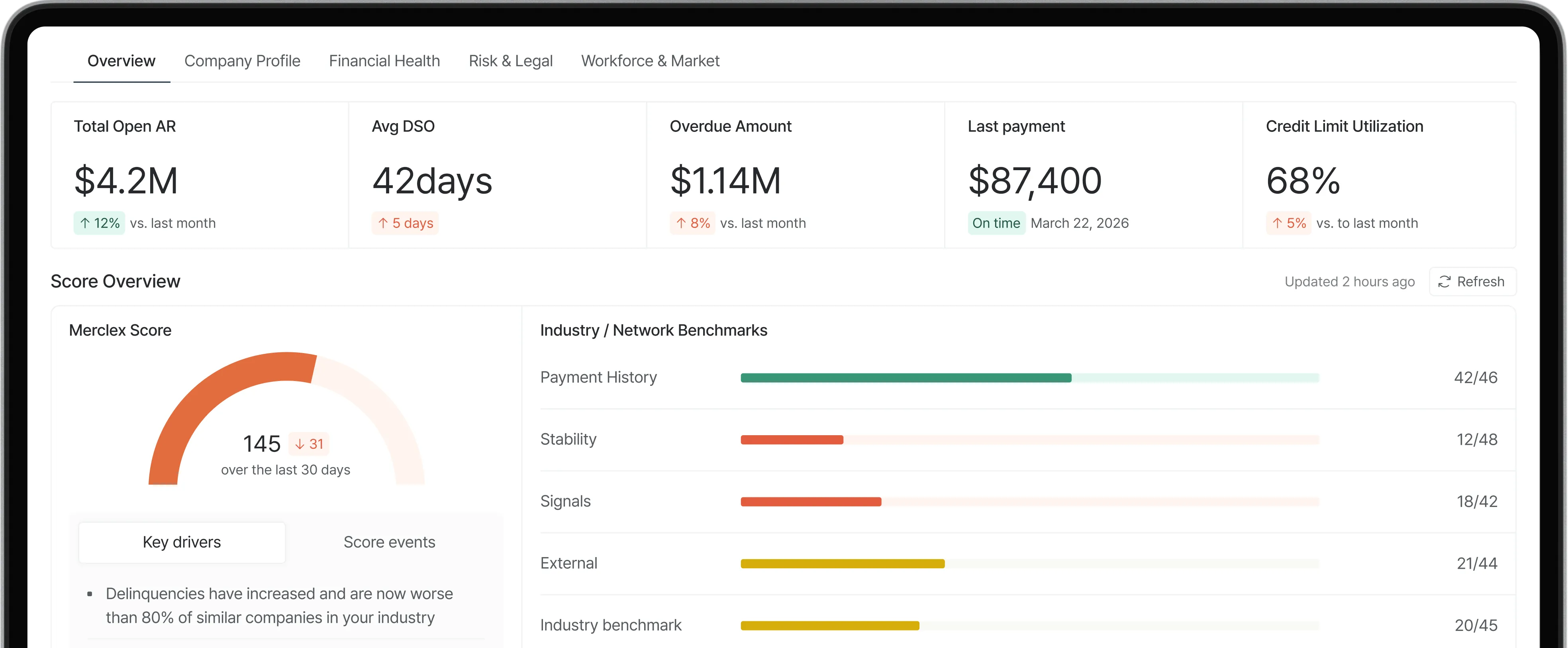
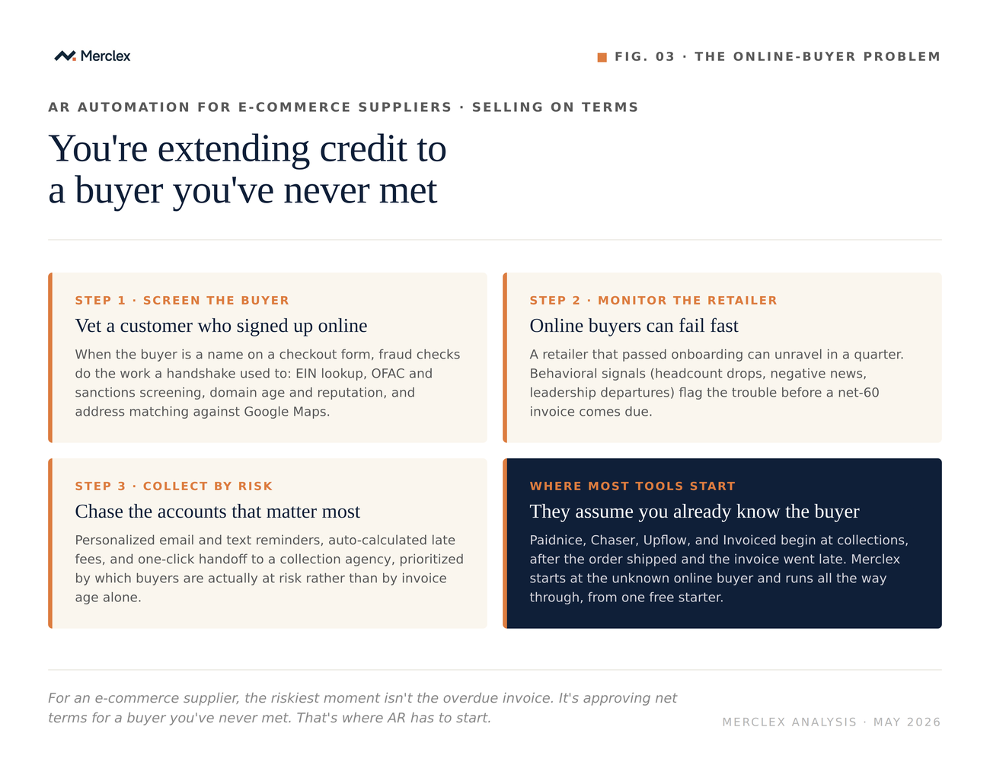
For an e-commerce supplier, the riskiest moment isn't the overdue invoice. It's approving net terms for a buyer you've never met. Most AR tools only show up after that, once the invoice is already late.
- Best overall: Merclex. The only tool that screens buyers at onboarding with fraud checks, monitors them for risk after you ship, and automates collections. Free starter tier.
- Best for financed net terms at checkout: Resolve. Credit-checks buyers, pays you upfront, carries the risk.
- Best paid collections value: Paidnice. $69/mo on Xero or QuickBooks, full suite, no revenue caps.
- Best for personalized chasing: Chaser. Reminders from your own email address, multi-channel follow-up.
- Best for scaling on NetSuite: Upflow. Free analytics tier, quote-based paid plans.
- Best mid-market AR for B2B distribution: Invoiced. AP-portal delivery, AI cash application, pay-as-you-go pricing.
The decision usually narrows to two: Merclex to screen and monitor buyers yourself for free, or Resolve to offload the credit risk entirely.
Best AR Automation Software for E-commerce Suppliers in 2026
If you supply other businesses, whether you're a wholesaler, a brand selling to retailers, or a distributor running a B2B e-commerce channel, your growth depends on offering net terms. Buyers expect 30, 60, or 90 days to pay, and the supplier who makes that easy wins the order. The catch is that every net-terms order is a small loan, and you're the bank. AR automation software is how e-commerce suppliers stop drowning in that lending operation.
The pressure is not hypothetical. 92% of businesses still get paid late, 44% of US B2B invoices are now overdue with 3% written off as bad debt, and US small businesses are owed more than $17,000 each on average in unpaid invoices. For a supplier shipping physical goods on thin margins, a single retailer that fails owing you a net-60 balance can wipe out the profit on a dozen good accounts.
Here's what makes e-commerce suppliers different from any other AR buyer. You're often extending credit to a customer you've never met. A retailer fills out a form on your B2B store, asks for terms, and you have to decide whether to ship thousands of dollars of inventory to a name and a domain. Generic AR tools assume you already know and trust the buyer; they pick up the story once an invoice is overdue. For a supplier, the riskiest moment happens long before that, at the point you approve terms for an unknown buyer.
This guide compares the best AR automation software for e-commerce suppliers in 2026, with the vertical's real priorities front and center: vetting buyers before you ship, managing net terms, monitoring the retailers you sell to, and automating collections. We'll cover what each tool does, what it costs, and which one closes the gap the others leave open.
The Best AR Automation Software for E-commerce Suppliers, Quickly
The best overall pick for e-commerce suppliers is Merclex, because it's the only tool that screens buyers at onboarding (with fraud checks built for customers you meet only online), monitors those buyers for risk after you ship, and automates collections, all from a free starter tier. For embedding net terms directly into your B2B checkout with financing attached, Resolve is the strongest specialist, handling buyer credit checks and paying you upfront on approved invoices.
For pure collections automation, Paidnice is the best paid value on Xero or QuickBooks at $69 per month, and Chaser is best for personalized, human-sounding reminders. Upflow suits suppliers scaling on NetSuite who want strong AR analytics, and Invoiced is the practical choice when you outgrow SMB collections tools and need mid-market-grade AR built for B2B distribution.
If you sell on net terms to buyers you onboard online, the decision usually comes down to two: Merclex to screen and monitor those buyers yourself for free, or Resolve to outsource the credit risk entirely through financed net terms. The rest are collections tools that work best once you already trust the buyer.
AR Software for E-commerce Suppliers at a Glance
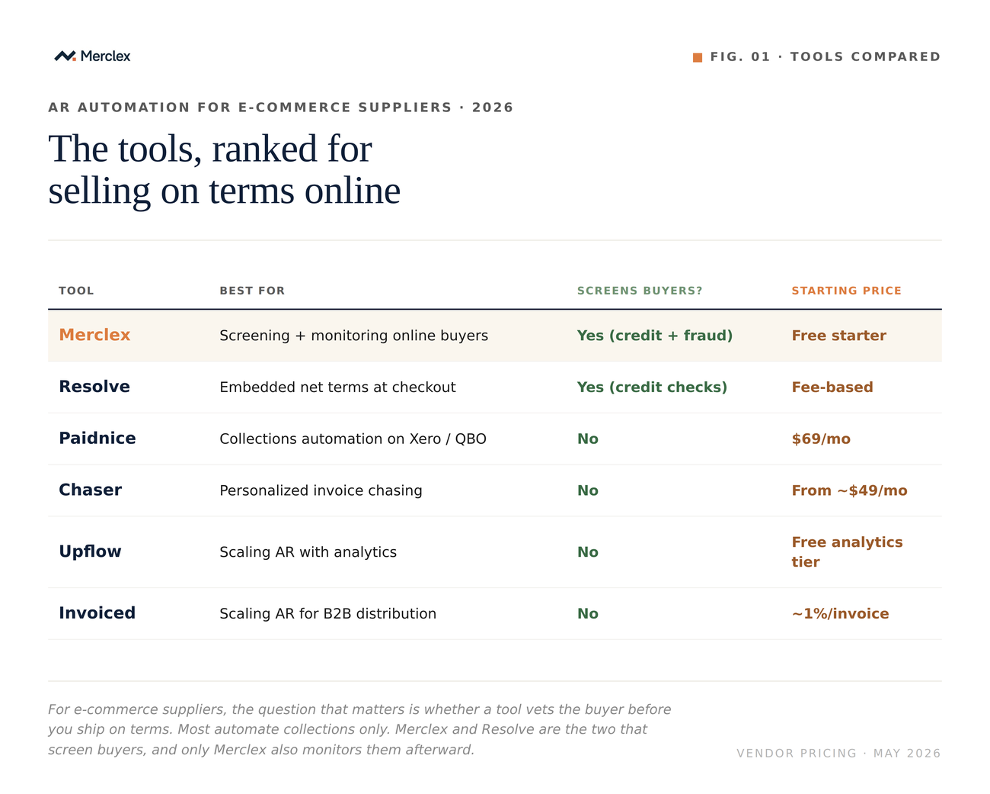
The table below compares the best AR automation tools for e-commerce suppliers on what they're best for, whether they screen buyers before you ship, and starting price. Full reviews follow.
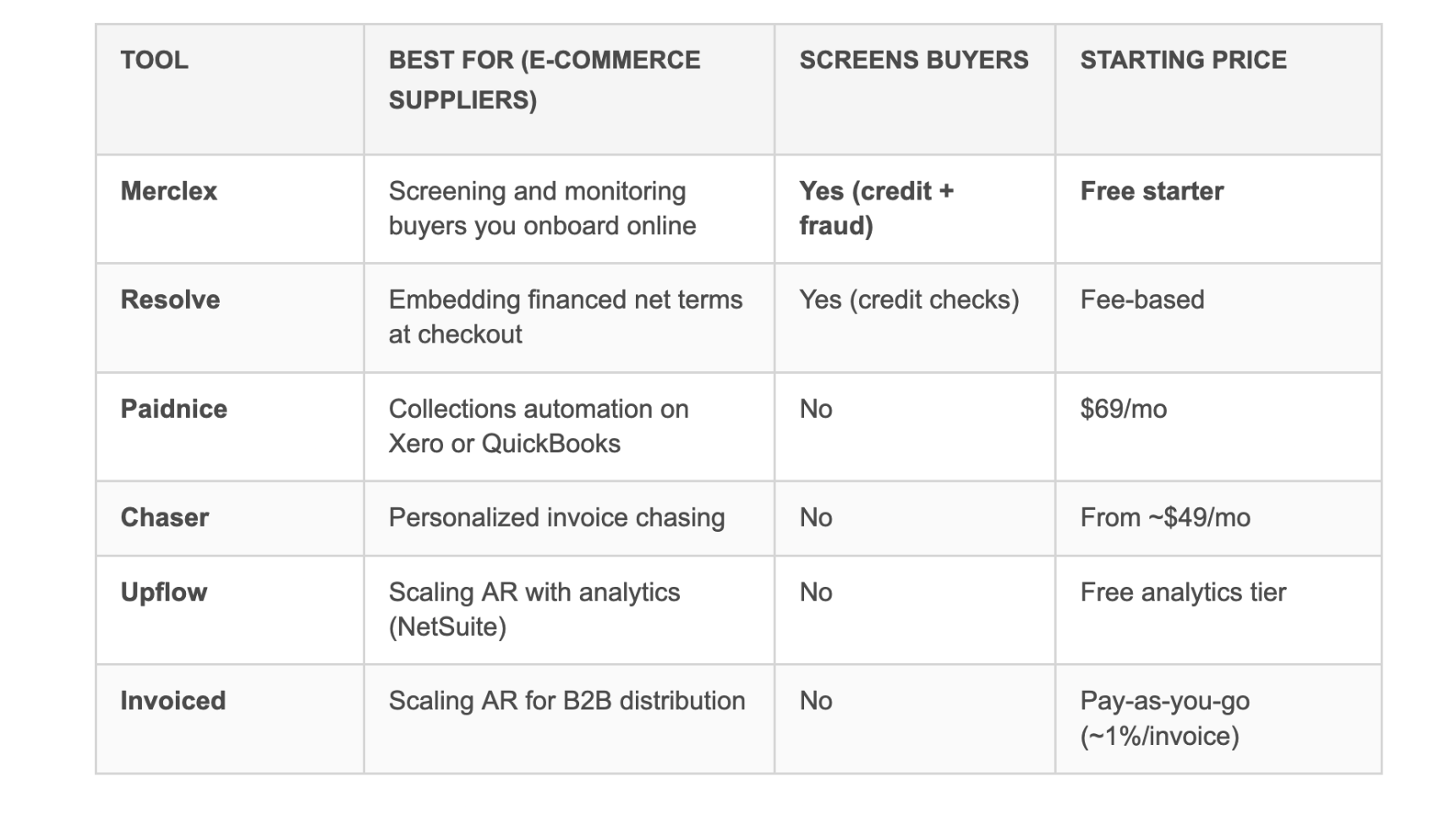
For e-commerce suppliers, the question that matters is whether a tool vets the buyer before you ship on terms. Most automate collections only; Merclex and Resolve screen buyers, and only Merclex also monitors them.
The 6 Best AR Tools for E-commerce Suppliers, Reviewed
Each review uses the same structure: at a glance, best for, pricing, overview, pros, cons, and verdict. Reviews are ordered by overall fit for an e-commerce supplier selling on net terms.
1. Merclex
At a glance: The only tool that screens online buyers at onboarding, monitors them for risk, and automates collections, with a free starter tier.
Best for: E-commerce suppliers extending net terms to retailers and buyers they onboard online.
Pricing: Free starter tier; paid plans scale with usage.
Overview
E-commerce suppliers face a problem most AR tools ignore: you approve terms for buyers you've never met. Merclex is built for exactly that moment. At onboarding, it runs an AI credit application with fraud checks designed for online buyers, including EIN lookup, OFAC and sanctions screening, domain age and reputation analysis, and address matching against Google Maps, then recommends credit terms. After you ship, it monitors each buyer for behavioral risk signals (leadership departures, headcount drops, negative news, earnings misses, lawsuits, and liens) so a retailer heading toward failure surfaces before your net-60 invoice comes due. Finally, it automates collections with personalized email and text sequences, auto-calculated late fees, and one-click handoff to a collection agency. It connects to QuickBooks, Sage, and Xero, and the starter tier is free.
Pros
• Fraud checks built for vetting buyers you only meet online.
• Monitors buyers for risk after onboarding, not just at signup.
• Full collections automation, plus a genuinely free starter tier.
Cons
• Not a financing product; it doesn't advance you cash on invoices the way Resolve does.
• Most valuable when you extend meaningful net terms.
• Newer than the established collections tools.
Verdict
For an e-commerce supplier, Merclex is the best overall pick because it works where your risk actually lives: at the unknown buyer you're about to ship to, and at the retailer whose business is quietly turning. It's the only tool here that screens, monitors, and collects, and the free starter makes it easy to test on your own buyers.
2. Resolve
At a glance: A net-terms specialist that credit-checks your buyers, pays you upfront, and carries the risk, embedded right in your B2B checkout.
Best for: Suppliers who want to offer financed net terms at checkout and offload credit risk entirely.
Pricing: Fee-based pricing tied to invoice volume and terms; non-recourse financing available.
Overview
Resolve is purpose-built for manufacturers, wholesalers, and distributors that want to offer net terms without becoming a lender. It runs automated business credit checks on your buyers, lets them check out on 30, 60, or 90 day terms, and pays you upfront on approved invoices while Resolve manages the collections and carries the risk on its non-recourse program. It integrates with NetSuite and QuickBooks alongside e-commerce platforms like Shopify and BigCommerce, with a branded buyer payment portal. For a supplier whose main goal is to extend terms aggressively while protecting cash flow, Resolve does something no pure collections tool does.
Pros
• Credit-checks buyers and underwrites net terms for you.
• Pays you upfront on approved invoices, with non-recourse risk transfer.
• Native e-commerce and ERP integrations (Shopify, BigCommerce, NetSuite, QuickBooks).
Cons
• Fee-based pricing costs more than running collections yourself.
• Built around financing terms, not monitoring buyers you keep in-house.
• Less useful if you don't want to offer financed terms.
Verdict
Resolve is the strongest specialist for suppliers who want to offer net terms at checkout and hand off the credit risk. It and Merclex solve different halves of the same problem: Resolve underwrites and finances the terms, while Merclex screens and monitors buyers you choose to carry yourself. Many suppliers will consider both.
3. Paidnice
At a glance: A full collections automation suite for Xero and QuickBooks users, and the best paid value for most suppliers.
Best for: Suppliers on Xero or QuickBooks Online that want complete collections automation at a flat price.
Pricing: From $69 per month with free trial, with no revenue caps.
Overview
Paidnice automates the full collections workflow: reminders, late fees, statements, payment plans, escalations, a customer payment portal, and AR reporting. It was named the 2025 Xero Global Small Business App of the Year and syncs two ways with both Xero and QuickBooks Online, so late fees and payments flow back into your books automatically. At $69 per month with no revenue caps, it's the best value for a supplier that wants thorough collections automation without per-user pricing. It assumes you've already decided to trust the buyer, so pair it with buyer screening if that matters.
Pros
• Complete collections feature set at a flat monthly price.
• Deep two-way sync with Xero and QuickBooks Online.
• No revenue caps, so cost stays predictable as your order volume grows.
Cons
• Collections only; no buyer credit checks or risk monitoring.
• No net-terms financing.
• Best suited to Xero and QuickBooks users specifically.
Verdict
Paidnice is the strongest pure collections tool for suppliers on Xero or QuickBooks. If you already have a handle on which buyers to trust and just need to automate the chasing well, it's the best paid value. It won't help you vet a new online buyer or flag a retailer going bad.
4. Chaser
At a glance: Collections automation built around personalized reminders sent from your own email address.
Best for: Suppliers who want to preserve retailer relationships while chasing payment.
Pricing: Three plans with a free trial; pricing is volume-based, with third-party listings around $49 to $369 per month.
Overview
Chaser focuses on collections that don't feel robotic. Reminders go out from your own email address with your own signature, so a retailer receives what looks like a personal note rather than a generic platform alert, which matters when you want to keep the account. It supports multi-channel follow-ups and integrates with Xero and QuickBooks. Users report getting paid around 16 days sooner and saving 15 or more hours a week. Reporting and customization are lighter than some rivals, and it lacks a NetSuite integration, which can matter if you plan to scale onto a larger ERP.
Pros
• Personalized reminders sent from your own email address.
• Strong reported results: paid ~16 days sooner, 15+ hours saved weekly.
• Solid Xero and QuickBooks integrations.
Cons
• Limited reporting and customization.
• No NetSuite integration.
• Collections only; no buyer screening or monitoring.
Verdict
Chaser is the right pick if relationship-preserving, personal-feeling reminders are your priority with retail buyers. It does collections well, but like the other collections tools, it acts on overdue invoices rather than warning you which buyers are about to become a problem.
5. Upflow
At a glance: A collections platform with strong AR analytics and a free analytics tier, well suited to suppliers scaling on NetSuite.
Best for: Growing suppliers who want clear AR analytics and run NetSuite or Stripe alongside their accounting.
Pricing: Free analytics tier; paid plans are quote-based (reported from around $440 per month).
Overview
Upflow treats collections as a customer-experience problem and pairs it with the cleanest AR analytics in the category. Its free analytics tier lets you track DSO, aging, and collection performance before committing, which is useful for a supplier trying to understand where cash is stuck across a growing buyer base. Paid plans add configurable dunning sequences, a customer payment portal, and shared timelines. It integrates with Stripe, QuickBooks, Xero, and NetSuite, which makes it a fit for suppliers outgrowing entry-level accounting tools.
Pros
• Free analytics tier to track DSO and aging before paying.
• Strong analytics and NetSuite support for scaling suppliers.
• Broad integrations including Stripe and NetSuite.
Cons
• Paid automation is quote-based and can start high.
• Collections focus; no buyer credit checks or risk monitoring.
• No net-terms financing.
Verdict
Upflow is the best fit for suppliers scaling up who want serious AR analytics and a NetSuite-ready platform. Start on the free analytics tier to diagnose your receivables. As with the other collections tools, it works best once you already trust the buyer.
6. Invoiced
At a glance: A mid-market-grade AR automation platform built for B2B sellers, with AI cash application and AP-portal invoice delivery.
Best for: Scaling suppliers who have outgrown SMB collections tools and sell to retailers that use AP portals.
Pricing: Advanced A/R is pay-as-you-go at roughly 1% per invoice issued; Enterprise A/R is custom-quoted.
Overview
Invoiced is purpose-built for B2B sellers running serious receivables, with documented strength in distribution, manufacturing, and B2B services. Its Invoice-to-Cash module covers automated invoicing, Smart Chasing for personalized collections, a self-service buyer portal, and AI-powered cash application (CashMatch) that reconciles incoming payments to invoices automatically. The detail that matters most for e-commerce suppliers: Invoiced delivers invoices across 260+ AP portals and buyer integrations, which is what selling to large retailers running Coupa, Ariba, or similar networks actually requires. Pricing on the Advanced A/R plan is pay-as-you-go at around 1% per invoice issued; Enterprise A/R is custom. Implementation is heavier than lightweight SMB tools, but you get more horsepower in return.
Pros
• Built for B2B sellers in distribution and manufacturing, the exact e-commerce supplier profile.
• Multi-channel invoice delivery across 260+ AP portals for selling to retailers.
• AI cash application reduces manual reconciliation work at high invoice volumes.
Cons
• 1% per invoice adds up on high-value receivables.
• Heavier implementation than lightweight collections tools.
• No buyer credit checks or fraud screening at onboarding.
Verdict
Invoiced is the right pick when SMB collections tools start showing their limits and you need AR built for serious B2B volume, especially if your retailer customers expect AP-portal invoice delivery. It handles the heavy lifting of mid-market AR well. Like the other collections-focused tools here, it won't vet a new online buyer or flag a retailer heading toward failure before the invoice is late.
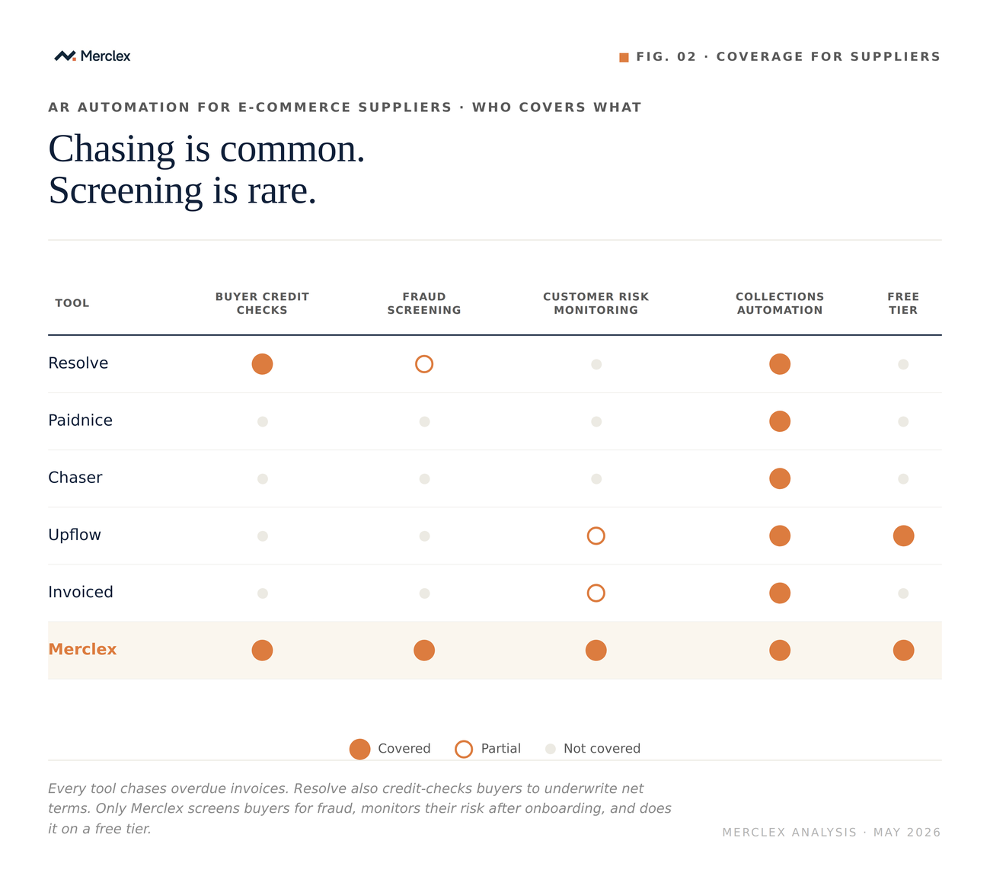
Every tool chases overdue invoices. Resolve also credit-checks buyers to underwrite net terms. Only Merclex screens buyers for fraud, monitors their risk after onboarding, and does it on a free tier.
What E-commerce Suppliers Should Look For in AR Software
The generic AR checklist (does it send reminders, does it sync with my books) misses what actually protects a supplier selling on terms. Here's what to weigh.
Can It Vet a Buyer You've Never Met
This is the question that separates supplier-grade tools from generic collections software. When a buyer requests terms through your B2B store, can the tool tell you whether they're real and creditworthy before you ship? Buyer credit checks and fraud screening (EIN, sanctions, domain age, address verification) are the difference between confidently approving terms and gambling on a name. Most collections tools skip this entirely; only Merclex and Resolve address it directly.
Does It Watch Buyers After Onboarding
A retailer that looked solid at signup can deteriorate in a quarter, and online sellers can collapse fast. Software that monitors your buyers for warning signs (headcount cuts, negative news, leadership departures) gives you time to tighten terms or pause shipments before a large balance goes bad. Reacting only when an invoice is overdue is reacting too late.
Does It Fit Your Sales and ERP Stack
Suppliers run on a mix of accounting tools, ERPs, and e-commerce platforms. Confirm native, two-way sync with whatever you use, whether that's QuickBooks, Xero, Sage, or NetSuite, and with your storefront if you sell through Shopify or BigCommerce. Without clean integration, automation creates reconciliation work instead of removing it.
Net Terms Yourself, or Financed
Decide whether you want to carry credit risk or hand it off. Carrying it yourself (with screening and monitoring from a tool like Merclex) keeps margin and control. Offloading it through financed net terms (Resolve) costs a fee but transfers the risk and pays you upfront. Many suppliers blend the two: finance the buyers they're unsure about, carry the ones they trust and monitor.
For an e-commerce supplier, the riskiest moment isn't the overdue invoice. It's approving net terms for a buyer you've never met. That's where AR has to start.
Enterprise Options for High-Volume Suppliers
Large distributors and manufacturers with complex, high-volume receivables may need enterprise order-to-cash platforms. These are powerful and priced accordingly, with multi-week implementations.
• Billtrust: enterprise billing and payments automation, strong in manufacturing, distribution, and wholesale, with broad AP-portal connections for delivering invoices across large B2B networks.
• TreviPay: a B2B credit and payments platform for enterprises selling across web, app, in-store, and partner networks, with credit decisioning and net terms at scale for dealer and distributor models.
• Quadient AR and Versapay: order-to-cash platforms with collections workflows, forecasting, and buyer-seller portals for mid-market and enterprise finance teams.
These suit suppliers with dedicated AR departments and high transaction volumes. For most growing e-commerce suppliers, the tools earlier in this guide deliver more value faster, and a free starter lets you begin today.
Frequently Asked Questions: AR Automation for E-commerce Suppliers
What is the best AR automation software for e-commerce suppliers?
For most e-commerce suppliers, Merclex is the best overall because it screens buyers at onboarding with fraud checks built for online customers, monitors them for risk afterward, and automates collections, all from a free starter tier. Resolve is the best specialist if you want to embed financed net terms at checkout and offload credit risk, and Paidnice is the best paid value for pure collections on Xero or QuickBooks.
How do e-commerce suppliers offer net terms safely?
Two approaches work. You can screen buyers yourself with a tool that runs credit checks and fraud screening at onboarding (Merclex) and monitor them afterward, keeping margin and control. Or you can use a financed net-terms platform (Resolve) that credit-checks buyers, pays you upfront, and carries the risk for a fee. Many suppliers blend both: finance uncertain buyers, carry and monitor trusted ones.
Why is AR harder for e-commerce suppliers than other businesses?
Because you often extend credit to buyers you've never met. A retailer requests terms through your online store, and you have to decide whether to ship inventory to a name and a domain. Generic AR tools assume you already trust the buyer and only act once an invoice is overdue, which leaves the riskiest moment, approving terms for an unknown buyer, completely uncovered.
How much does AR automation software cost for suppliers?
It varies widely. Chaser starts from about $49 per month on volume-based pricing; Paidnice is $69 per month with no revenue caps; Invoiced charges roughly 1% per invoice issued on its Advanced A/R plan, with custom pricing at the Enterprise tier. Upflow has a free analytics tier with quote-based paid plans, Resolve uses fee-based pricing tied to invoice volume, and Merclex has a free starter tier.
Does AR automation actually reduce late payments for suppliers?
Yes. Businesses that use AR automation are 52% more likely to be paid within two weeks, and most teams cut DSO by 10 to 20 days. For suppliers, the bigger win is avoiding the worst losses entirely by screening buyers before shipping and monitoring them for risk, rather than only chasing invoices after they go overdue.
Which AR tools integrate with Shopify or BigCommerce?
Resolve integrates natively with e-commerce platforms including Shopify and BigCommerce to offer net terms at checkout, alongside NetSuite and QuickBooks. Merclex connects to QuickBooks, Sage, and Xero for the accounting and collections side. Confirm current integration support with each vendor for your specific storefront and ERP.
The Bottom Line for E-commerce Suppliers
Any tool in this guide beats running net terms from a spreadsheet. If you want straightforward collections, Paidnice is the best paid value, Chaser is best for personalized chasing, and Upflow suits suppliers scaling on NetSuite. If you want to offer financed net terms at checkout and offload the credit risk, Resolve is the specialist built for it.
But for an e-commerce supplier, the deepest risk isn't the overdue invoice. It's the moment you approve terms for a buyer you've never met, and the weeks afterward when a retailer you trusted starts to slip. Collections tools don't touch either moment. Merclex is the one option here that screens online buyers with real fraud checks, monitors them for risk after you ship, and then automates collections by who's actually most likely to default, all from a free starter. For a supplier, that's the difference between getting paid late and shipping inventory you never get paid for at all.