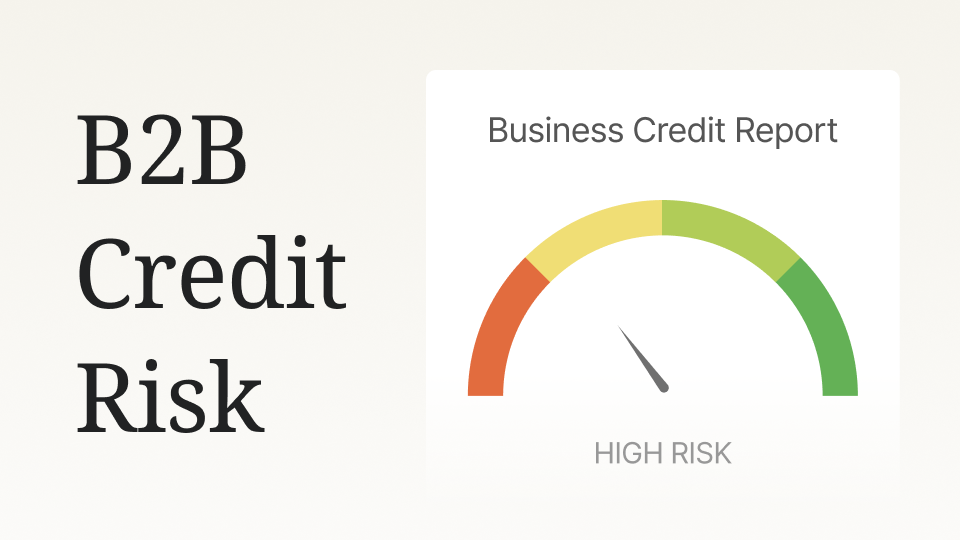
- Credit risk is the probability a customer fails to pay what they owe, and the loss that follows. In B2B trade, you take it on every time you ship before payment.
- The credit risk on a single customer is Expected Loss = EAD × PD × LGD (exposure × probability of default × loss given default). Same formula banks use under Basel III.
- Five operational types of credit risk: payment, default, concentration, dilution, and country or industry. Each has a different mitigation.
- The four strategies to manage credit risk are avoid, reduce, accept, or transfer. Trade credit insurance is one transfer option, not the default answer.
- Median B2B bad debt write-off runs 1% to 2% of AR per year. Above 3% you are taking too much risk for typical B2B margins.
This guide is informational and draws on publicly available data from NACM, Federal Reserve, Atradius, and Allianz Trade. It is not financial, legal, or insurance advice.
How we built this guide
The framework below comes from public B2B payment data (NACM, Atradius, Federal Reserve, Allianz Trade) and direct evaluation of how mid-market B2B sellers actually run credit functions in 2026. Operator version, not textbook version.
What is credit risk?
Credit risk is the probability that a counterparty fails to pay what they owe under the terms of an agreement, plus the financial loss that follows from that failure. In B2B trade, you take on credit risk every time you ship a product or deliver a service before the customer has paid.
If your customer pays cash on delivery or prepays, you have no credit risk. The moment you offer net 15, net 30, or any other delayed payment terms, you are an unsecured creditor ranking behind banks, secured lenders, and tax authorities if your customer goes into distress.
This matters because the trade credit market is enormous. The Federal Reserve estimates US trade credit exposure at over $5 trillion, larger than commercial and industrial bank lending and SME bank lending combined. Most companies extend more credit to other companies than banks do. According to NACM, 43% of US B2B credit sales are currently overdue, and bad debt write-offs run 1% to 4% of accounts receivable annually depending on industry.
A B2B company doing $50M in annual sales on terms is statistically going to write off $500K to $2M every year as uncollectible. The point of credit risk management is to bring that number down through better customer selection, terms structuring, and monitoring.
What are the types of credit risk in B2B trade?
There are five operational types of credit risk in B2B trade, and they require different mitigations.
- Payment risk is the risk of slow payment rather than non-payment. The customer is solvent and will eventually pay, but past terms. The hit lands on your DSO and working capital, not your bad debt line. Atradius reports the average US B2B payment runs 26 days past terms.
- Default risk is the risk of non-payment ending in write-off, bankruptcy, or settlement at cents on the dollar. The historical base rate of B2B default in the US runs 0.5% to 2% per year, concentrated in the bottom credit tiers and certain industries (construction, restaurants, retail).
- Concentration risk is the risk of being too exposed to a single customer or correlated group. Standard thresholds: no single customer over 10% of AR, no single industry over 25%. A diversified portfolio absorbs defaults. A concentrated one does not.
- Dilution risk is the risk that an invoice gets reduced in value before payment for reasons other than credit (returns, disputes, deductions, chargebacks, pricing errors). The customer pays, but pays less than face value. Dilution can run 1% to 5% of revenue in industries with heavy promotional activity, often larger than the bad debt rate. It is the most overlooked B2B credit risk.
Country and industry risk is the risk that a customer's environment, rather than the customer themselves, drives default. Solvent customers can become insolvent because their industry collapses (commercial real estate in 2025) or their country enters a payment crisis.
How do you calculate credit risk?
The credit risk on a single customer is the product of three numbers: your exposure, the probability they default, and the share of exposure you would lose if they did.
Expected Loss = Exposure at Default × Probability of Default × Loss Given Default
Or in shorthand: EL = EAD × PD × LGD. This is the same framework banks use under Basel III.
- Exposure at Default (EAD) is the unpaid invoice balance plus any open credit limit you have already authorized. A customer with $100K unpaid and a $50K open limit has EAD of $150K.
- Probability of Default (PD) is the probability the customer fails over the relevant horizon (usually one year). Credit scores like Intelliscore Plus, PAYDEX, and Equifax Business Credit Risk Score estimate this. A PD of 0.02 means 2% in the next year.
- Loss Given Default (LGD) is the share of your exposure you lose if they default. In B2B trade with no collateral and a position behind secured lenders, LGD typically runs 70% to 100%. With a personal guarantee or trade credit insurance, LGD drops materially.
A worked example: a customer with $200K EAD, 3% PD, and 80% LGD has $4,800 of expected annual credit loss. Sum across customers to get portfolio expected loss as a percentage of AR. Median is 1% to 2%.
The point of the math is not precision to the dollar. It is to compare customers and decide where to deploy mitigation. High EAD plus high PD warrants insurance or a personal guarantee. Low EAD plus high PD warrants a credit limit reduction. High EAD plus low PD warrants ongoing monitoring.
How do you manage credit risk?
Once you have quantified credit risk on a customer, you have four strategic options.
Avoid. Decline to extend credit. The customer pays cash on delivery, prepays, or buys from someone else. The right move when expected loss is large enough to materially damage your business if the customer defaults, with no economic mitigation. Avoiding credit risk is not the same as turning down business: many B2B sellers handle high-risk customers on prepay and keep the relationship.
Reduce. Extend credit on terms that lower your exposure or your loss. Lower the credit limit, shorten the payment window, require a deposit or partial prepayment, take a personal guarantee from the owner, file a UCC-1, or require monthly statements. The most common strategy and the most flexible. Apply in graduated form across the customer base.
Accept. Take the credit risk and price it into your margin. The right strategy for the bulk of low-risk customers in any portfolio, where the cost of mitigation exceeds expected loss. Accepting is not the same as ignoring: you still score, set the limit, and monitor. Accept means no extra mitigation beyond your standard policy.
Transfer. Move the financial impact to a third party in the business of carrying credit risk. The three transfer tools in B2B trade are trade credit insurance (most common), factoring without recourse (sell the receivable, the factor carries the credit risk), and letters of credit (the customer's bank stands behind the obligation, common in international trade). Most appropriate for high-EAD, high-PD customers where expected loss is material and concentrated.
The four strategies are not mutually exclusive. A real credit policy uses all four across different segments: avoid the bottom 5%, reduce on the next 25%, accept on the middle 60%, transfer on the top 10% by exposure.
What should a B2B credit risk policy include?
A B2B credit risk policy worth the name has six components: a credit application, customer tiering, scoring inputs, decision thresholds, payment terms by tier, and a documented review cadence.
Most credit policies in the wild are one paragraph in an employee handbook. That is not enough to make consistent decisions, and it leaves you exposed when a declined customer alleges discrimination. A real policy fits on two to three pages and reads like an operating manual.
- Credit application. Standardized form every prospective credit customer signs. Captures legal entity name, EIN, state of incorporation, principal owners, trade references, bank reference, and FCRA consent for personal credit pulls.
- Customer tiering. Three to five risk tiers (typically low, medium, high, decline) based on your scoring. Tiers determine credit limit, payment window, and monitoring intensity.
- Scoring inputs. Specify what data sources go into the decision: bureau report (D&B, Experian, Equifax, Creditsafe, or a modern alternative), trade references, financial statements, public records, contextual signals (LinkedIn headcount, news, leadership).
- Decision thresholds. Translate scores into outcomes. Low risk gets standard terms, medium gets reduced limits, high gets cash on delivery, decline gets no terms.
- Payment terms by tier. Spell out what each tier qualifies for so sales cannot negotiate around the policy on a customer-by-customer basis.
- Review cadence. Customers above a defined exposure threshold get reviewed quarterly. All customers re-pulled annually. Material change events trigger immediate re-review.
A policy with these six components gives you consistency, defensibility, and a way to onboard new credit team members in a week instead of a year.
What are the warning signs of rising credit risk?
The warning signs of rising credit risk in an existing customer fall into three categories: payment behavior, observable business changes, and external events. The earliest signals are usually contextual rather than financial.
Payment behavior. Rising DBT (Days Beyond Terms) trend, partial payments where full payments were the norm, requests to extend payment windows, sudden disputes on previously-uncontested invoices, bounced checks, failed ACH attempts. A single missed payment is noise. Three consecutive months is signal.
Observable business changes. Senior leadership departures (especially CFO), headcount declines on LinkedIn, public layoff announcements, missed product launches, analyst downgrades for public companies, sustained service degradation. The Atradius Payment Practices Barometer consistently finds leadership turnover and headcount changes are the strongest predictors of B2B default outside of payment behavior itself.
External events. Industry-wide shocks (commercial real estate in 2025, hospitality in 2020), regulatory changes, the customer's largest customer entering distress, key supplier bankruptcies, credit rating downgrades for public customers.
Practical rule: any single warning sign warrants a re-pull and a conversation. Two simultaneous signs warrant a credit limit reduction or terms tightening. Three simultaneous signs warrant treating the relationship as a workout candidate, with no new credit extended until the situation clarifies.
Is trade credit insurance worth it?
Trade credit insurance is worth it when your portfolio has high concentration, large average exposures, or international customer base. It is usually not worth it when your portfolio is highly diversified across small US-only customers.
Trade credit insurance (TCI) is a contract under which an insurer (Allianz Trade, Atradius, Coface, Cover) covers a defined percentage of your AR (typically 80% to 95%) against customer default. Premiums run 0.10% to 0.40% of insured turnover.
The honest case for TCI: it transfers concentrated risk off your balance sheet, gives you working capital flexibility (lenders advance more against insured AR), and gives you an outside underwriting check on customers (the insurer's analyst is paid to spot problems before you do).
The honest case against: the premium can exceed your historical loss rate. The coverage has carve-outs (existing past-dues, certain industries, certain countries are excluded). Claims take 60 to 180 days. And the insurer can pull or reduce coverage on individual customers when their risk rises, exactly when you need it most.
The math: if your annual bad debt is 0.5% of revenue and TCI premium is 0.30%, the economics work, especially counting the lending advantage. If your annual bad debt is 0.05% (very diversified, very prudent screening) and TCI premium is 0.30%, you are paying six times your expected loss for the coverage. The numbers do not work.
A middle path most operators end up at: use TCI selectively on the top 10 to 20 customers by exposure where expected loss is material and concentrated, and self-insure the long tail of smaller customers where diversification handles the risk.
Frequently asked questions about B2B credit risk
What is credit risk in simple terms?
Credit risk is the chance that someone you have lent to or extended credit to fails to pay you back, and the amount you lose when that happens. In B2B trade, you take on credit risk every time you ship before the customer has paid. The two parts of credit risk are the probability of default and the loss if default happens.
How do you calculate expected loss from credit risk?
Expected loss = Exposure at Default × Probability of Default × Loss Given Default. A customer with $100,000 of open exposure, a 4% probability of default, and an 80% loss-given-default has $3,200 of expected annual credit loss. Sum across all customers to get portfolio expected loss, tracked as a percentage of AR over time.
How much B2B credit risk is acceptable?
The B2B median bad debt write-off rate is 1% to 2% of AR per year. Above 3% you are taking too much risk for typical B2B margins. Below 0.5% you may be turning down profitable business through over-conservative screening. The right level depends on your gross margin: high-margin businesses can absorb more credit risk than low-margin businesses.
Can B2B credit risk be insured?
Yes, through trade credit insurance from carriers like Allianz Trade, Atradius, Coface, and several specialist underwriters. Premiums run 0.10% to 0.40% of insured turnover. Coverage typically pays 80% to 95% of the unpaid invoice in the event of default. TCI is most economical for portfolios with concentrated exposure to a small number of large customers.
What is the most overlooked B2B credit risk?
Dilution risk. Most credit functions focus on default and payment risk and underweight dilution (the customer pays less than invoice face value because of returns, deductions, disputes, or chargebacks). Dilution can run 1% to 5% of revenue in industries with heavy promotional activity, often larger than the bad debt rate.
How Merclex fits into modern B2B credit risk management
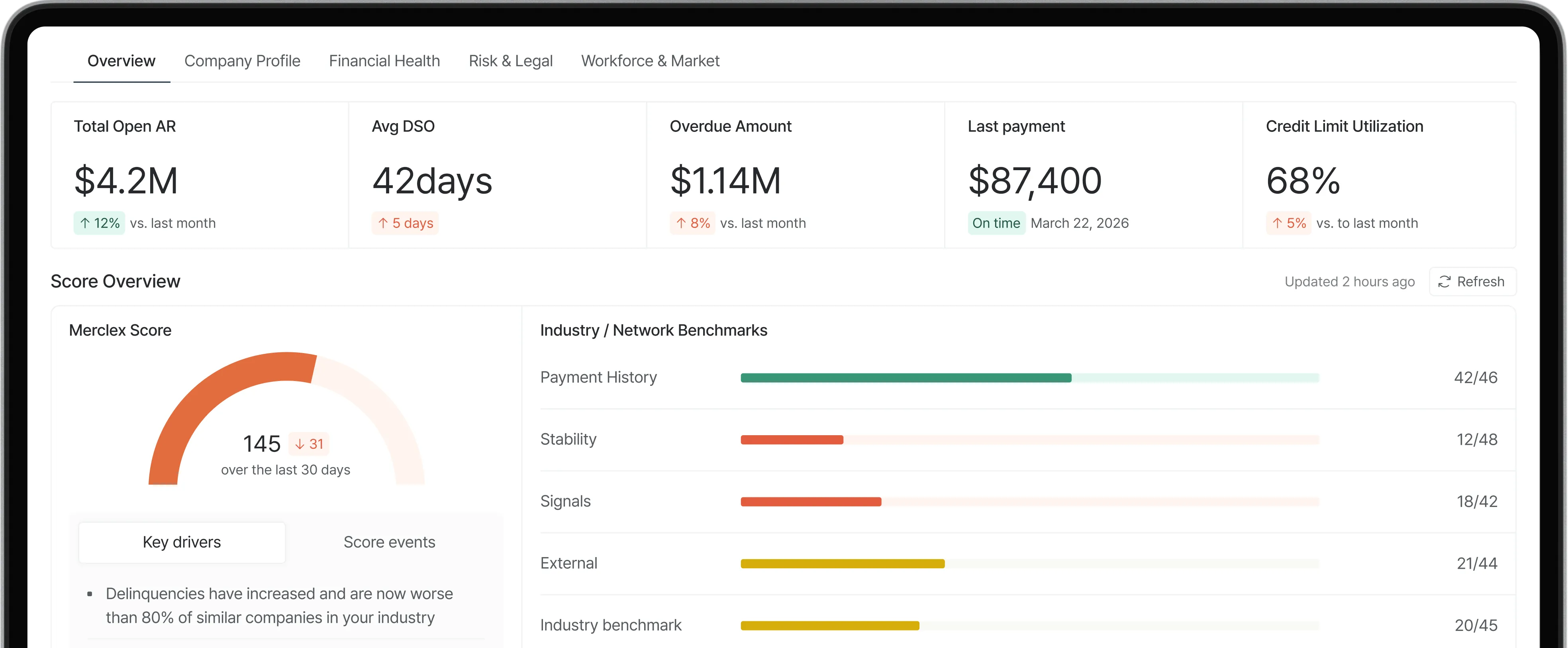
The biggest shift in B2B credit risk management since 2015 is the move from monthly bureau snapshots to real-time monitoring with contextual signals. Merclex was built for that shift. It integrates directly with QuickBooks, Sage, and other ERPs to pull AR data automatically, layers traditional trade payment data on top of contextual signals (LinkedIn headcount, leadership changes, news sentiment), and runs AI prioritization on alerts so your team focuses on the customers that matter this week.